⭐ PRE-CHAPTER INTRODUCTION
Before You Begin: A Message to Every New Trader
Most beginners enter the world of options with excitement, hope, and ambition…
and within weeks, they face the same painful cycle:
random entries
confusing premium behavior
losses they don’t understand
emotional decisions
revenge trades
“what just happened?” moments
sudden blowups
zero consistency
It’s not because they are careless.
It’s because options trading is brutally complex… until someone explains it the right way.
This guide is that explanation.
This is not a normal blog post.
It is not a 1,500-word shallow article like most websites publish.
It is a complete trading education, broken down into 20 deeply structured, beginner-friendly, step-by-step chapters.
You are about to learn:
how options actually work (in simple words)
why 90% of traders lose & how not to be one of them
the exact entries and exits professionals use
how to avoid OTM traps
how to control fear, greed, FOMO, anxiety
how to build your own trading system
how to think like a disciplined professional
how to avoid catastrophic losses
how to protect capital and grow consistently
Most importantly…
**You will stop trading emotionally
and start trading systematically.**
If you read this guide carefully,
if you follow the rules,
if you practice with discipline…
Then this guide will help you:
✔ cut losses
✔ avoid traps
✔ protect your capital
✔ increase accuracy
✔ maintain consistency
✔ reduce stress
✔ survive volatility
✔ and finally start becoming profitable
Most traders fail because they never invest the time to understand the market properly.
But you chose to read a 20-chapter mega guide —
that alone puts you ahead of 95% of the crowd.
Do yourself a favor:
**Read this entire guide once.
Save it.
Then read it again.
And then start applying it chapter by chapter.**
This guide can compress years of experience into a few days of reading…
and save you from mistakes that cost traders lakhs every year.
Trading is not a game.
It’s a serious skill.
Treat this guide like a textbook, not a casual blog post —
because the knowledge inside it is enough to transform your entire trading journey.
Now take a deep breath…
let’s begin your evolution as a trader.
⭐ CHAPTER 1 – THE MARKET BEFORE OPTIONS
(Understanding the Game Before Learning the Instruments)
Before You Learn Options, You Must Learn the Market’s Language
Let’s begin at the beginning.
Most beginners jump straight into:
- Calls
- Puts
- Premium
- Greeks
- ITM / OTM
- Strategies
…without ever truly understanding what the market is.
Trying to understand options without understanding the market underneath is like trying to read Shakespeare before learning the alphabet.
Options are built on top of the market.
To master them, you need to understand the market’s heartbeat first.
And that’s what this entire chapter is about.
The Market Is NOT What We Think It Is
Ask someone what the stock market is, and they’ll say:
“It’s where people buy and sell stocks.”
But that answer is as incomplete as saying:
“The ocean is just water.”
The market is a living system —
a dynamic ecosystem where:
- Greed breathes
- Fear screams
- Logic whispers
- Liquidity flows
- Prices dance
- Opinions clash
- Narratives dominate
- Money moves like currents under the surface
Options are simply the language built on top of this ecosystem.
Before learning options, we must understand:
- How price moves
- Why price moves
- What drives trends
- What creates levels
- Why the market behaves irrationally
- Why volatility exists
- Who the players are
Because options pricing, behavior, Greeks, strategies —
ALL of them are built on the foundation of this market behavior.
The True Identity of the Market
(A Story You Will Never Forget)
I want to give you an analogy that will stay with you forever.
Imagine you are standing in front of a giant, ancient elephant.
This elephant is:
- Majestic
- Powerful
- Unpredictable
- Wise
- Emotional
- Slow at times
- Aggressive at others
Tons of people around you are trying to predict what the elephant will do next:
- Some believe it will turn left
- Some believe it will charge forward
- Some believe it will sit
- Some believe it will stay still
- Some believe it will panic and run
Every person has a different opinion.
Now remember:
**The elephant = The market.
The people around = Traders, investors, institutions.**
The elephant doesn’t care about anyone’s opinion.
It simply moves according to:
- Its mood (market sentiment)
- Its fears (risk)
- Its instincts (fundamentals)
- Its environment (news & macros)
- Shadows it sees (rumors & expectations)
- Unexpected sounds (events & shocks)
This is why:
- Markets go up when everyone expects a fall.
- Markets crash when everything seems perfectly fine.
- Markets move sideways when news is explosive.
- Markets explode when news is silent.
The elephant moves on its own logic, not yours.
Price = The Elephant’s Footprints
You rarely see the elephant directly.
You only see its footprints in the sand.
In markets:
**Price is simply the visible footprint
of the invisible forces underneath.**
Options, by the way, are priced almost entirely based on:
- Price
- Speed of price
- Fear about price
- Expectation of price
- Time until price moves
This is why deep understanding of price movement is essential for options mastery.
The 5 Forces That Move the Market
Every price movement — big or small — is caused by five universal forces.
Force 1: Fundamentals
EPS, growth, inflation, interest rates, corporate earnings, GDP…
This affects long-term price.
Force 2: Liquidity
Where is institutional money flowing?
Force 3: Sentiment
Fear, greed, uncertainty, panic, confidence.
This is the strongest force in short-term markets.
Force 4: Technical Structure
Support, resistance, supply/demand zones, patterns, volume.
Force 5: Volatility & Expectations
This is the foundation of options pricing.
Volatility =
“How much uncertainty is expected from the elephant?”
We will deep dive into this in later chapters.
The Market Is Driven by Players (and You Must Know Them)
Think of the market as a giant stadium.
Inside this stadium, four major players are competing:
- Retail Traders
Small fish.
Most emotional.
Often late to trends.
Driven by fear and greed.
Easily shaken out.
Often trade OTM options without understanding.
- Institutions (FIIs / DIIs)
Whales.
Move slowly, strategically, with deep planning.
Move the market with billions.
These are the people who create:
- Levels
- Support
- Resistance
- Major price moves
- Smart Money / HNIs
Agile sharks.
They enter quietly, exit quietly, but profit consistently.
They trade structure, not emotions.
They love options because options allow:
- hedging
- leverage
- controlled risk
- structured payouts
- Market Makers
They are the invisible architects behind option premiums.
Their job:
provide liquidity and manage risk, not speculate.
Market makers care about:
They are the reason option prices behave the way they do.
They are the invisible puppeteers behind the scenes.
Price, Volume, and Trend
(The Holy Trinity Before Options)**
Before touching options, you must understand:
- Price shows direction
- Volume shows strength
- Trend shows intention
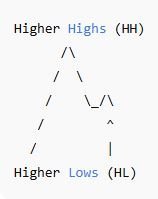
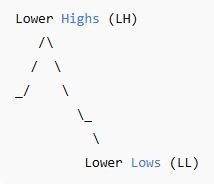
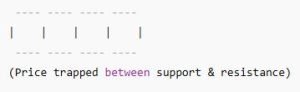
And here is your first diagram to visualize trend:
UPTREND
DOWNTREND
SIDEWAYS
The future chapters on Greeks, IV, and strategies will build heavily on these structures.
(The Elephant’s Favorite Spots)**
Imagine the elephant walking on a path.
There are soft muddy patches where it likes to rest (support).
There are rocky areas it avoids or gets stuck (resistance).
Here is a clean visual:
Support
↓ Price falls
————————-
| SUPPORT |
————————-
↑ Reversal
Resistance
↑ Price rises
————————-
| RESISTANCE |
————————-
↓ Rejection
Institutions love to:
- accumulate on support
- distribute on resistance
Options strategies like condors, credit spreads, iron flies heavily rely on these levels.
Volatility (The Elephant’s Mood Swings)
Volatility is the single most important concept in options trading.
But before we dive into IV (Implied Volatility) later, you must understand:
Volatility = “How violently the elephant might move.”
It measures:
- uncertainty
- fear
- excitement
- expected movement
Volatility doesn’t care about direction.
Only magnitude.
Later in the guide, you will learn why:
- IV increases premiums
- IV crush destroys buyers
- IV drives Vega
- IV can override Delta
- IV dictates strategy selection
This chapter lays the foundation for that.
Price is Truth — Everything Else is Interpretation
In trading:
- News is delayed
- Opinions are biased
- Predictions are illusions
- Indicators lag
But price does not lie.
This is why:
The best options traders are first excellent price-action readers.
Because options are built directly on:
- price
- rate of change of price
- expectation of price
- fear of price
- time left for price to move
Everything comes back to this.
Why This Chapter Matters Before Options
Most traders fail at options because they:
- don’t understand market structure
- don’t know how price behaves
- don’t understand volatility
- don’t understand levels
- don’t think in probabilities
- don’t understand who they are trading against
- don’t see options as risk tools, not lottery tickets
This chapter builds the mindset required to interpret GREKS, moneyness, IV, OI, strategies, and risk later.
You now understand:
- the elephant (market)
- its footprints (price)
- its moods (volatility)
- its preferences (levels)
- its environment (fundamentals)
- its interactions (players)
This is the foundation for the next chapter.
⭐ CHAPTER 2 – WHAT EXACTLY ARE OPTIONS?
A MASTERCLASS FOR TRUE BEGINNERS
Before We Begin: The Goal of This Chapter
By the end of this chapter, you will understand options so clearly that:
- You can explain them to a child
- You will NEVER confuse calls/puts again
- Risk/reward will make intuitive sense
- Premium pricing will feel logical
- Buyers vs Sellers will feel like characters in a story
- You will actually “feel” what an option is
This is not a shallow textbook-like explanation.
This is a masterclass, written for someone who must understand options at the DNA level.
Let’s begin.
The Real-Life Origin Story — The Fruit Vendor and the Farmer
Before options existed on exchanges, options existed in life.
Let me tell you a story that explains options better than 100 definitions.
A Farmer & A Seller
A mango farmer is worried:
“What if mango prices fall at harvest?
I might suffer a loss.”
A fruit trader is worried:
“What if mango prices suddenly rise?
I won’t be able to afford stock.”
Both want stability.
Both want protection.
Both want certainty.
So they strike a deal:
The Deal (Option Contract)
The trader says:
“I want the right to buy 1,000 kg of mangoes
from you at ₹50/kg next month.”
The farmer says:
“Okay, but give me ₹2 per kg TODAY
to keep this right reserved for you.”
THIS is the premium.
- Trader = Option Buyer
- Farmer = Option Seller (Writer)
- ₹50/kg = Strike Price
- ₹2/kg = Premium
- Next month = Expiry
If mango prices rise to ₹80/kg
The trader will happily exercise his right:
Buy at ₹50 → Sell at ₹80 → Profit
The farmer must sell at ₹50 even though market is ₹80.
He suffers loss — BUT he took ₹2 premium initially.
If mango prices fall to ₹30/kg
The trader will NOT exercise the right.
He will buy from the open market at ₹30.
The farmer gets to keep the premium ₹2/kg for nothing.
This, in its purest essence, is a Call Option.
You now understand:
- Right
- Strike
- Premium
- Buyer
- Seller
- Expiry
- Profit
- Loss
- Obligation
Without a single technical word.
Options Are Rights — Not Obligations
This is the golden rule:
Option Buyer = Has Right (No Obligation)
Option Seller = Has Obligation (No Right)
Below table help you to memorize it:
ROLE | NATURE |
+———————-+————————+
| Option Buyer | Right, but no duty |
| Option Seller | Duty, but no right |
+———————-+————————+
The buyer buys a right.
The seller sells that right and takes on the obligation.
This is why:
Buyers have limited risk.
Sellers have unlimited (or very large) risk.
We’ll explore this with examples soon.
Two Types of Options: CALLS & PUTS
Options come in only two flavors.
You master these two,
you master all strategies later.
CALL OPTION
Right to BUY something at a fixed price (strike).
You buy a call when you think price will go up.
PUT OPTION
Right to SELL something at a fixed price (strike).
You buy a put when you think price will go down.
Call vs Put — Super Simple Chart
| IF YOU EXPECT PRICE | OPTION TO BUY |
+————————-+—————————+
| Go Up | Call Option (CE) |
| Go Down | Put Option (PE) |
+————————-+—————————+
A Beautiful Analogy: Call Option = Movie Ticket
You buy a movie ticket for ₹300.
Does the ticket FORCE you to watch the movie?
No.
It gives you a right to watch.
If you don’t go, worst-case:
You lose the ₹300 premium.
Exactly how a call option behaves.
Option Structure
An option has 4 key components:
- Underlying (Stock/Index)
- Strike Price
- Premium
- Expiry
Here’s how an option contract looks:
UNDERLYING : NIFTY |
| TYPE : CALL |
| STRIKE : 20,000 |
| PREMIUM : 120 |
| EXPIRY : 27 FEB 2025
This contract gives the buyer the right to buy NIFTY at 20,000.
Real Indian Market Example (Simplest Possible)
NIFTY Spot = 20,000
You think NIFTY will go up.
You buy:
20,000 CE @ ₹120
If NIFTY moves to 20,300:
Premium might go → ₹250
Profit = (250 – 120) × Lot Size
If NIFTY stays below 20,000:
Premium → 0
Loss = premium paid only.
Put Option — Explained Like Magic
Put options confuse beginners the most.
Let’s make it crystal clear.
Buying a Put = You bought a parachute.
You profit when prices fall,
just like a parachute helps when you drop.
Simplest Example
NIFTY = 20,000
You buy:
20,000 PE @ ₹100
If NIFTY crashes to 19,700:
Premium might go → ₹250
Huge profit.
If NIFTY stays above 20,000:
Premium → 0
Loss = premium only.
Why Option Buyers Love Options
- Low capital
- Limited risk
- Unlimited upside (for calls)
- Hedge against crashes
- Perfect for trend following
- No obligation
Why Option Sellers Dominate the Market
This is where we get premium.
See this table:
+————————+————————-+
| BUYER | SELLER |
+————————+————————-+
| Limited Risk | Unlimited Risk |
| Unlimited Reward | Limited Reward |
| Low Win Rate | High Win Rate |
| Needs Big Moves | Benefits from Stability |
+————————+————————-+
Buyers are betting on movement.
Sellers are betting on no movement.
- Buyers play offense
- Sellers play defense
But sellers earn steady income —
which is why major institutions are sellers.
The Breakthrough Concept: Options = Insurance
Options were NEVER designed for speculation.
They were created as insurance products,
centuries before exchanges existed.
A call option = Insurance against price rising
A put option = Insurance against price falling
Today traders use them for:
- Directional trades
- Income
- Volatility plays
- Hedging
- Arbitrage
…but the soul of options remains → insurance.
This is why:
- Sellers (insurance companies) earn steady premium
- Buyers (insurance buyers) make money only during rare, large events
You now understand the industry’s core truth.
Understanding Premium (WHY It Exists)
Premium is NOT random.
Premium =
Intrinsic Value + Time Value + Volatility Value
This will be explored deeply later.
But here is a metaphor:
Premium = The cost of renting certainty in an uncertain world.
Buyers pay for certainty.
Sellers get paid to take uncertainty.
Why Expiry Exists? (The Clock That Always Wins)
Options cannot exist forever.
Just like:
- Milk expires
- Movie tickets expire
- Insurance contracts expire
Options have a time limit.
Time decay is the silent killer —
we will dive deeply in Chapter 5.
Visual — Buyer vs Seller Battle
BUYER (Wants Movement) SELLER (Wants Stability)
——————————————————-
Big price moves No big moves
High volatility Low volatility
Trend Range-bound
Low probability High probability
High reward Small reward
Limited risk Unlimited/large risk
This dynamic is the soul of options trading.
Why This Chapter Was Critical Before Greeks, IV & Strategies
You now understand:
- Calls & puts
- Premium
- Rights & obligations
- Buyer vs seller
- Insurance analogy
- Basic payoff logic
- Real examples
- Diagrams
- Origins of options
- Why expiry exists
This is the foundation for everything ahead.
The rest of the guide will become 10x easier for you now.
⭐ CHAPTER 3 – MONEYNESS, STRIKE SELECTION & INTRINSIC VALUE
The Most Misunderstood Concepts Simplified to the Core
Before We Begin — Why This Chapter Is Crucial
Most beginners lose money in options not because they choose the wrong direction…
…but because they choose the wrong strike.
Think about it:
You were right about the trend.
You were right about the movement.
You even picked the correct side (call or put).
Yet you still lost.
Why?
Because moneyness, intrinsic value, and strike selection are the real backbone of profitable option trading.
This chapter will make these three concepts so clear that you will NEVER buy the wrong strike again.
Let’s begin.
First, What Is a Strike Price? (The Doorway to Your Option)
Think of a strike price as a door you choose before entering a house.
Different doors lead to different rooms:
- Some rooms give you flexibility
- Some rooms give you speed
- Some rooms give you safety
- Some rooms give you risk
- Some rooms give you lottery-like outcomes
- Some rooms give you slow, steady outcomes
Choosing the wrong door = you end up in the wrong room.
Strike selection works the same way.
What Is Moneyness? (The Distance From Reality)
Moneyness is simply:
Where your strike price stands in relation to the current market price.
There are only 3 types:
- ITM (In The Money)
- ATM (At The Money)
- OTM (Out of The Money)
Let’s decode them like a story.
ATM — “The Current Battlefield”
The Strike Closest to the Current Market Price
If NIFTY is 20,000:
- 20,000 CE = ATM
- 20,000 PE = ATM
ATM is where the market is currently fighting.
PRICE
↓
—————–
| ATM Strike |
—————–
ATM options have:
- The highest volatility
- Fast premium movement
- Highest gamma
- Unpredictable swings
ATM is like standing on the battlefield frontline.
ITM — “Inside the House Already”
In-The-Money means:
Your strike is already better than the market price.
For Calls: ITM = Strike Below Spot
NIFTY = 20,000
19,900 CE → ITM
19,800 CE → ITM
For Puts: ITM = Strike Above Spot
20,100 PE → ITM
20,200 PE → ITM
ITM ← Spot Price → OTM
ITM options:
- Cost more
- Have higher Delta (faster response)
- Are more stable
- Lose less from time decay
ITM is like entering a race 10 meters ahead of others.
OTM — “The Lottery Ticket Zone”
Out-of-the-money means:
Your strike is worse than the current market price.
For Calls: OTM = Strike Above Spot
NIFTY = 20,000
20,200 CE → OTM
20,300 CE → OTM
For Puts: OTM = Strike Below Spot
19,800 PE → OTM
19,700 PE → OTM
ITM ← Spot Price → OTM (Cheap but Low Probability)
OTM options:
- Are cheap
- Look attractive
- Have tiny Delta
- Move slowly
- Often expire worthless
- Are the biggest trap for beginners
OTM is like entering a race 50 meters behind competitors.
You can win…
but you probably won’t.
The Golden Formula: Premium = IV + Time Value + Intrinsic
Let’s break it down.
1️⃣ Intrinsic Value (IV₁): The Real Value
Intrinsic value is:
“How much the option is worth right now if exercised.”
For Calls:
Intrinsic = Spot – Strike
For Puts:
Intrinsic = Strike – Spot
Only ITM options have intrinsic value.
2️⃣ Time Value: The Possibility Value
Time value is:
“How much extra value exists because time is left.”
Time = Hope.
Time = Chance.
Time = Expectation.
Time value exists for ALL options (ITM, ATM, OTM).
3️⃣ IV (Implied Volatility): The Fear Value
This is:
“How uncertain/unpredictable the market is.”
When volatility is high, premiums inflate like balloons.
Detailed Example — Breaking Down Premium
NIFTY Spot = 20,000
20,000 CE = Premium ₹120
Let’s break it:
- Intrinsic = 0 (ATM)
- Time Value = 75
- Volatility Value = 45
Total = 120
This is why ATM is volatile:
- Zero intrinsic
- High time value
- High IV sensitivity
Deep Example — ITM Call Breakdown
NIFTY Spot = 20,000
19,800 CE = Premium ₹270
Intrinsic = 200
Time Value = 70
Total = 270
Premium = 200 (Intrinsic) + 70 (Time)
Why ITM is expensive?
Because it already has money embedded in it.
Deep Example — OTM Call Breakdown
NIFTY Spot = 20,000
20,400 CE = Premium ₹25
Intrinsic = 0
Time Value = 25
Total = 25
Premium = 0 + 25(100% pure time value)
This is why OTM collapses fast →
Time has no mercy.
The Single Biggest Beginner Mistake: Buying Deep OTM
Let’s illustrate with an example.
NIFTY Spot = 20,000
Beginner buys 20,700 CE at ₹5 hoping to become rich.
This is the payoff zone:

You need HUGE movement.
Low probability.
Time decay kills quickly.
Sellers love when beginners buy these.
The Professional Way: Delta-Based Strike Selection
This is where pros shine.
Delta is a Greek we’ll study later — but for now:
Delta measures how sensitive premium is to price movement.
Professional traders choose strikes based on Delta ranges.
✔ For Option Buyers (Directional Traders):
- Slight ITM (Delta 0.55–0.65)
- ATM (Delta 0.45–0.55)
These react fast.
These reward trending markets.
✔ For Option Sellers (Income Traders):
- OTM strikes (Delta 0.15–0.25)
- Safe distance from spot
- High probability of expiring worthless
Buyers seek: Δ = 0.5 to 0.7
Sellers seek:Δ = 0.1 to 0.25
You will master this in Chapter 4 (Greeks).
The 20-Strike Probability Rule (Institutional Method)
This is an advanced but simple rule:
**The further the strike from spot,
the lower the probability of touching.**
Probability drops exponentially as you move away from ATM.
Let’s illustrate:
NIFTY Spot = 20,000
Strike | Type | Touch Probability |
20,000 | ATM | 50% |
20,100 | OTM | 35% |
20,200 | OTM | 20% |
20,300 | DEEP OTM | 10% |
20,400 | DEEP OTM | 5% |
This is why ITM/ATM behave differently from OTM.
Visualization — Strike Bands
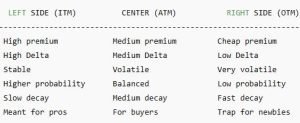
This table alone can change your entire approach.
Which Strike Should YOU Choose? (The Final Answer)
✔ If you are a beginner → Choose ATM or Slight ITM
Ideal Delta: 0.50–0.65
Why?
- Responds well
- Not too expensive
- Not too slow
- Not too risky
- Not too decaying
Perfect balance.
✔ If you are a trend trader → Choose Slight ITM
Ideal Delta: 0.60–0.70
Why?
- Stronger premium movement
- Lower time decay impact
- Higher stability
✔ If you are a breakout trader → Choose ATM
Best for momentum plays.
Explosive gamma movement.
✔ If you are an expiry scalper → Choose ATM (but with experience)
Super fast movement.
High risk.
High reward.
✔ If you are a conservative hedged seller → Sell OTM spreads
Strike: Delta 0.15 to 0.25
Why?
- Safer
- Time decay advantage
- Limited risk
Summary of This Chapter
You learned:
- What moneyness is
- How strikes relate to price
- Intrinsic value
- Time value
- Volatility value
- Why OTM is a trap
- Why ITM is powerful
- Why ATM is volatile
- Delta-based strike selection
- Institutional probability method
- Complete buyer/seller strike logic
This chapter forms the backbone of:
- Greeks (Chapter 4)
- IV (Chapter 5)
- Strategy selection (Chapters 7–12)
- Hedging (Chapter 13)
You now deeply understand the internal architecture of strike pricing.
⭐ CHAPTER 4 – THE GREEK GOD CHAPTER
Delta, Gamma, Theta, Vega — Explained Like You’re 12
Before We Begin (Read This Slowly)
Options pricing is NOT random.
Premium moves because of Greeks.
If you understand Greeks, you understand:
- why your premium increased
- why it didn’t increase
- why it fell
- why it collapsed
- why your trade behaved opposite to what price did
- why OTM died
- why ATM exploded
- why ITM behaved predictably
- why expiry day feels like a war zone
Without Greeks, option trading is pure gambling.
With Greeks, option trading becomes mathematics, logic, and probabilities.
This chapter will make Greeks feel intuitive — almost obvious.
Let’s begin.
Delta — The Speed of Your Option
(The First Greek You Must Master)
Delta tells you:
For every 1 point move in the underlying, how much will the premium move?
Meaning:
- If Delta = 0.50
And NIFTY moves +10
Premium moves +5
Think of Delta as the speedometer of your option.
Delta Explained With a Very Simple Story
Imagine you are cycling uphill.
Some cycles move faster.
Some move slower.
- ITM options = gear cycles (fast)
- ATM options = normal cycles
- OTM options = cycles with flat tires (slow)
- Deep OTM = cycles with broken chains (very slow)
This is Delta.
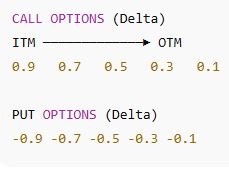
Delta Values (Memorize This Table)
For Call Options (CE):
- ITM → High Delta (0.60–0.90)
- ATM → Medium Delta (0.45–0.55)
- OTM → Low Delta (0.25–0.35)
- Deep OTM → Very low Delta (0.05–0.20)
For Put Options (PE):
- ITM → High negative Delta (–0.60 to –0.90)
- ATM → Around –0.50
- OTM → –0.30
- Deep OTM → –0.10
Why Delta Matters
Delta tells you:
- how fast your premium will react
- how much you’ll gain on movement
- how much you’ll lose on reversals
- how stable vs unstable the option is
- how likely an option is to expire ITM
High Delta = High probability of finishing ITM
Low Delta = Low probability of finishing ITM
This is why professionals never buy deep OTM.
Delta is near zero →
Premium barely moves →
Full premium loss.
Gamma — The Acceleration of Your Option
(How Fast the Speed Changes)
If Delta is speed,
Gamma is the acceleration.
Gamma tells you:
How fast Delta will change if the price moves.
Gamma is highest at ATM.
This is why:
- ATM options behave like rockets
- OTM suddenly become ITM
- ITM suddenly become deep ITM
- Premium jumps feel magical
- Expiry moves feel violent
Gamma is the Greek responsible for expiry madness.
Gamma Behavior Table
ITM ATM OTM
Low HIGH Low
Gamma looks like a volcano:
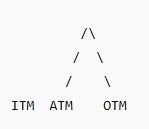
The peak is ATM.
Why Beginners Love Gamma (Without Knowing It)
Every time a beginner trades:
- “Breakout candle”
- “Momentum spike”
- “Sudden reversal”
- “Huge move”
…and sees premium shoot up suddenly…
That’s Gamma at work.
They think it was magic.
It wasn’t.
It was Gamma + Delta expansion.
Why Expiry Day Is Dangerous (Gamma Explosion)
On expiry day:
- Premium is low
- Time left is near zero
- Gamma explodes
- Delta changes rapidly
- ATM behaves like lightning
Small price changes → massive premium jumps.
This is why:
- Expiry scalping is addictive
- Premium jumps are crazy
- Reversals kill instantly
Gamma = the drama Greek.
Theta — Time Decay (The Silent Killer)
Theta tells you:
How much premium you lose every day just because time passes.
Options are rented assets.
Every passing minute charges rent.
Buyers HATE Theta.
Sellers LOVE Theta.
Simple Theta Example
If Theta = –10
Every day your premium falls by ₹10, even if price does NOTHING.

This is decay.
And it NEVER stops.
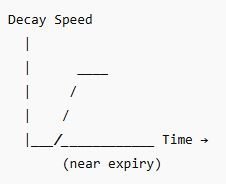
Theta Decay Timeline (Super Important)
Far from Expiry: Slow Decay
Near Expiry : Fast Decay
Expiry Week : Very Fast Decay
Expiry Day : Brutal Decay
visual:
Weekend Theta — The Silent Deduction
Saturday + Sunday decay happens at once.
A Friday option will open lower on Monday even if price didn’t move.
Because the clock doesn’t stop.
(The Greek That Makes or Breaks Your Trade on News Days)
Vega tells you:
How much premium will move when volatility (IV) changes.
If IV rises → Premium rises
If IV falls → Premium falls
Vega loves:
- news
- uncertainty
- gaps
- events
- panic
- trend reversals
Vega is strongest in ATM options.
When Does IV Rise?
- Volatile markets
- Before big news
- Before earnings
- Before elections
- Before RBI policy
- During global crises
- During uncertainty
High IV = high premium
When Does IV Fall? (IV Crush)
After events finish:
- Budget
- Results
- RBI update
- Fed announcement
- Election results
Suddenly premiums collapse.
This is why even CORRECT directional trades lose money on event day.
Buyers get IV crushed.
Sellers earn huge.
Rho — The Forgotten Greek
Interest-rate sensitivity.
Not very relevant for intraday or weekly expiry.
Ignored by most retail traders.
We keep it simple.
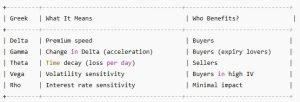
Summary Table for All Greeks
Real Market Example — Understanding All Greeks Together
NIFTY = 20,000
20,000 CE = Premium ₹120
Greek snapshot:
- Delta = 0.45
- Gamma = 0.12
- Theta = –8
- Vega = 5
Let’s interpret:
✔ If NIFTY moves +10 → premium moves +4.5 (Delta)
✔ If NIFTY keeps trending → Delta increases (Gamma)
✔ If price stays flat → premium loses ₹8/day (Theta)
✔ If IV rises → premium increases ₹5 for every IV jump (Vega)
This is REAL option behavior.
Comparing Greeks by Moneyness (Extremely Important)
ITM OPTIONS
Delta = High
Gamma = Low
Theta = Medium
Vega = Low
Stable. Predictable. Slow decay.
ATM OPTIONS
Delta = Medium
Gamma = High
Theta = High
Vega = High
Volatile. Exciting. Dangerous.
OTM OPTIONS
Delta = Low
Gamma = Low
Theta = High
Vega = Low
Cheap but dangerous.
Why Beginners Lose Money (The Greek Explanation)
❌ They buy OTM (low Delta)
Premium barely moves.
❌ They buy near expiry (high Theta)
Premium evaporates.
❌ They buy before news (high Vega)
Get IV crushed.
❌ They don’t understand Gamma
Get whipsawed on expiry.
Greeks explain nearly ALL beginner losses.
The Professional Rules (The Greek Framework)
Here are the 10 elite rules:
✔ Rule 1 — Buy high Delta
Choose ATM or slight ITM.
✔ Rule 2 — Sell low Delta with hedges
OTM spreads.
✔ Rule 3 — Avoid buying when Theta > 7% of premium
Too much decay.
✔ Rule 4 — Avoid buying in high IV
Wait for IV to cool.
✔ Rule 5 — Avoid selling in low IV
Premium is poor.
✔ Rule 6 — On expiry, Gamma rules everything
Stay small.
✔ Rule 7 — Vega dominates during event weeks
Expect inflated premiums.
✔ Rule 8 — Theta is king for sellers
Time is your ally.
✔ Rule 9 — Delta is king for buyers
Trend is your engine.
✔ Rule 10 — Master Greeks → Master options
Summary of Chapter 4
You now understand:
- Delta = Speed
- Gamma = Acceleration
- Theta = Decay
- Vega = Volatility effect
- How Greeks differ across strikes
- Why ATM moves like madness
- Why OTM dies fast
- Why ITM is stable
- Why expiry behaves like fireworks
- Why IV crush destroys buyers
- Why sellers rely on Theta
- Why buyers rely on Delta
You have just learned the soul of option pricing.
This is the true turning point in your learning journey.
⭐ CHAPTER 5 – IMPLIED VOLATILITY (IV) & IV CRUSH
The Invisible Hand Behind Every Premium
Why This Chapter Matters More Than You Think
If Chapter 4 (Greeks) was the “soul” of options…
Then Implied Volatility (IV) is the invisible force that controls everything the soul interacts with.
Most beginners lose money because they:
- Buy options when IV is high
- Get trapped in IV Crush
- Don’t understand why premium collapses
- Don’t know when IV matters vs price
- Don’t understand why premium doesn’t rise even when price moves
- Don’t know when to buy or sell based on IV
This chapter removes all confusion.
You’ll understand IV so well that you’ll “feel” it while trading.
Let’s begin with a story.
The Pressure Cooker Story — The Best IV Analogy Ever
Imagine a pressure cooker on a stove.
Inside the cooker:
- Heat increases
- Pressure builds
- Steam expands
The cooker begins shaking.
You don’t know when it will whistle,
but you know it will whistle soon.
That pressure building inside the cooker = IMPLIED VOLATILITY.
It represents:
- Expectations
- Fear
- Anticipation
- Uncertainty
- Potential explosion
Now imagine someone suddenly turns off the stove.
Pressure drops instantly.
This sudden collapse = IV CRUSH.
Premiums collapse the same way the pressure disappears from a cooker once the heat is turned off.
This analogy is the foundation for this entire chapter.
What EXACTLY is Implied Volatility (IV)?
(The Real Definition in Simple Words)**
Implied Volatility means:
How much movement the market EXPECTS in the future.
Key word: expects
Not past volatility.
Not actual volatility.
Not real movement.
But expected movement.
summary:
ACTUAL Volatility = Past movement
IMPLIED Volatility = Expected future movement
Options are priced based on the future — not the past.
This is why IV is often MUCH more important than price.
Why Does IV Matter So Much?
(Simple but Powerful Insight)**
Because:
High IV = High Premium
Low IV = Low Premium
Even if price doesn’t move.
Premium is literally inflated or deflated by IV.
visualization:
IV ↑ → Premium ↑
IV ↓ → Premium ↓
Which means:
You can lose money even when price moves in your direction
if IV drops.
This is the #1 reason beginners get confused.
The Balloon Analogy (Best Explanation of IV)
Imagine two balloons:
🎈 Balloon A — tightly stretched (high pressure)
🎈 Balloon B — loosely filled (low pressure)
If you push Balloon A,
it reacts fast,
because it’s full of pressure (high IV).
If you push Balloon B,
it reacts slow,
because there’s no pressure (low IV).
Options behave the same way.
Price vs IV (The Two Drivers of Premium)
Premium has two engines:
- Price movement
- IV movement
Most beginners think engine #1 is the only one.
They ignore engine #2.
Sometimes IV is SO powerful that:
IV fall > Price rise
→ Premium falls (loss)
OR
IV rise > Price fall
→ Premium rises (profit)
This is why options feel “illogical” until you understand IV.
When Does IV Rise? (The Fear Index)
IV rises when uncertainty increases.
Situations that increase IV:
- Elections
- Budget
- RBI meeting
- Fed meeting
- Earnings
- War fears
- Sudden gaps
- Crashes
- Major events
- Global volatility
- Breaking news
- Unexpected political or geopolitical situations
When fear rises → premiums inflate.
Fear ↑ → IV ↑ → Premium ↑
This is why event weeks have expensive options.
When Does IV Fall? (The Calm After The Storm)
IV falls when uncertainty disappears.
Situations that decrease IV:
- After earnings
- After elections
- After RBI speech
- After budget
- After major event
- After news is fully out
- After a large predictable move
Fear ↓ → IV ↓ → Premium ↓
This leads to IV Crush, the enemy of all beginners.
What Is IV Crush? (The Silent Assassin of Option Buyers)
IV Crush means:
Premium collapses instantly because volatility expectation disappears.
It can destroy option buyers within seconds.
It happens especially:
- On event days
- After earnings
- After big announcements
- After high-IV periods
- After overnight news
- After sudden resolution of uncertainty
Example:
Before event:
- IV = 28%
- Premium = ₹200
After event:
- IV = 12%
- Premium = ₹90
You lose money even if price moved in your direction.
This is IV Crush.
Real-Life Example — Election Day IV Crush
NIFTY = 19,900
20,000 CE premium = ₹350
IV = 30%
After results:
- NIFTY jumps to 20,300
- Premium should increase, right?
But IV collapses from 30% → 14%
Premium actually falls to ₹220
You were right about direction
You were right about trend
But IV worked against you.
This is the moment where 99% beginners say:
“Yaar, premium kyun gira? Nifty toh upar gaya.”
This chapter is the answer.
Why IV Matters More Than Direction on News Days
On normal days:
Price movement > IV movement
Premium behaves predictably.
On event days:
IV movement > Price movement
Premium behaves “weirdly.”
Remember:
Event = Uncertainty
Post-event = Certainty
Markets hate uncertainty and remove it aggressively.
IV, Vega, and Premium — The Perfect Triangle
IV is connected to the Greek called Vega.
Vega tells you:
“How much premium will change if IV changes by 1%?”
Example:
Option Vega = 4
If IV increases by 5% → Premium increases by 20 points
If IV decreases by 5% → Premium collapses by 20 points
Even if price doesn’t move.
IV → Vega → Premium
How Professionals Use IV (Institutional Grade Logic)
Pro traders:
- Buy when IV is low
- Sell when IV is high
- Avoid buying before events
- Sell premium before events
- Buy after IV crush
- Sell when IV spikes
- Use IV Rank to compare current IV to history
- Use IV Percentile to evaluate relativity
Professionals think in probabilities, not emotions.
IV Rank & IV Percentile — Simplified Genius
These two concepts are often misunderstood.
Let’s decode them perfectly.
IV Rank (IVR)
IV Rank tells you:
“Compared to the last 1 year, is today’s IV high or low?”
Example:
- IVR = 70
Means IV is higher than 70% of the last 1-year data.
Higher IVR → Sell
Lower IVR → Buy
IV Percentile (IVP)
IV Percentile tells you:
“How many days in the last year had IV lower than today?”
Example:
- IVP = 80
Means today’s IV is higher than 80% of days.
Same logic:
High IVP = sell
Low IVP = buy
The Institutional Rule (Very Important)
✔ BUY options when IV is low
Trend traders love low IV.
✔ SELL options when IV is high
Income traders love high IV.
IV Low → Buy
IV High → Sell
If you follow nothing else but this, you will avoid 70% of beginner mistakes.
Expiry Week IV Behavior (Hidden Secret)
Expiry week has a different IV structure:
✔ Time value collapses
✔ IV often collapses
✔ Gamma rises
✔ Vega becomes weak
✔ Direction + speed matter more
Conclusion:
Expiry week is great for selling, risky for buying.
The Most Important IV Rule Every Trader Must Know
❌ DO NOT BUY options when IV is high
(Especially before events)
✔ DO BUY when IV is low
(Especially after event or in calm markets)
❌ DO NOT SELL when IV is low
(No juice in premium)
✔ DO SELL when IV is high
(Overinflated balloons)
If you reverse these rules, you will lose money consistently.
If you follow them, you will grow consistently.
Summary — IV Behavior Map
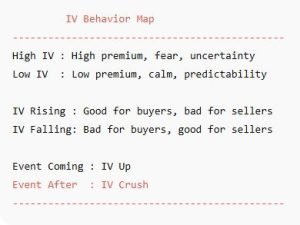
Chapter Summary
You now understand:
- What IV really is
- Why premium inflates
- Why premium collapses
- How IV affects buyers
- How IV affects sellers
- What IV crush is
- When IV rises
- When IV falls
- IV Rank
- IV Percentile
- Vega & IV connection
- Why event days are dangerous for beginners
- Why sellers love high IV
- Why buyers love low IV
This chapter unlocks the pricing behavior behind options.
From here onward, strategy selection becomes logical.
You’re ready for the next chapter.
⭐ CHAPTER 6 – OPTION CHAIN, OPEN INTEREST (OI), PCR & MAX PAIN
Reading Market Intent Like a Professional Trader
Why This Chapter Matters More Than You Think
Options trading without reading the Option Chain, OI, and PCR is like driving blindfolded.
Anyone can enter a trade.
Only professionals enter trades after reading where the big money is positioned.
This chapter makes you capable of reading the market like:
- Institutional traders
- Market makers
- Professional option writers
- Advanced hedgers
- Volatility traders
By the end of this chapter:
- Support & resistance will look obvious
- Trend continuation/reversal will make sense
- OI buildup patterns will feel intuitive
- PCR sentiment will be easy to interpret
- Max Pain will become a natural tool
Let’s start.
What Is an Option Chain? (The Market’s Dashboard)
The Option Chain is a list of all:
- strikes
- premiums
- calls
- puts
- open interest
- IV
- bid–ask
- Greeks
- volumes
It’s the X-ray report of the entire options market.
It tells you:
- where traders are buying
- where traders are selling
- where institutions are building levels
- where support/resistance sits
- where expiry might gravitate
- what sentiment is developing
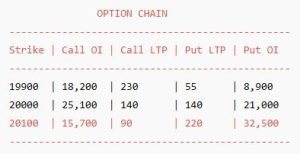
Every row tells a story.
What Is Open Interest (OI)?
(The Foundation of Institutional Trading)
OI = Number of open outstanding contracts
Not volume.
Not trades.
Not prices.
It represents positions that exist.
✔ High OI = lots of interest
✔ Low OI = little interest
✔ Increasing OI = new money entering
✔ Decreasing OI = old money exiting
OI is the footprint of big players.
OI Buildup — The Four Patterns Used by Institutions
Institutions leave footprints through OI.
There are only 4 patterns you must master.
1️⃣ Long Build-Up
Price ↑ and OI ↑
→ Traders are buying
→ Bullish sentiment
Price ↑
OI ↑
Sentiment → Bullish
2️⃣ Short Build-Up
Price ↓ and OI ↑
→ Traders are selling
→ Bearish sentiment
Price ↓
OI ↑
Sentiment → Bearish
3️⃣ Short Covering
Price ↑ and OI ↓
→ Bears are closing positions
→ Bullish reversal
Price ↑
OI ↓
Sentiment → Bullish Reversal
4️⃣ Long Unwinding
Price ↓ and OI ↓
→ Bulls are closing
→ Bearish reversal
Price ↓
OI ↓
Sentiment → Bearish Reversal
These four patterns are the holy grail of reading intention.
Call OI vs Put OI — How Big Money Creates Support & Resistance
Calls = resistance
Puts = support
Why?
Because:
Sellers write calls at resistance
Sellers write puts at support
Sellers are usually smart money.
So:
- High Call OI zone → strong resistance
- High Put OI zone → strong support
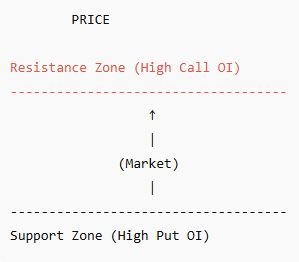
This chart alone makes option chain reading 10x easier.
How to Identify Strong Support & Resistance Using Option Chain
Let’s say NIFTY is 20,000.
You scan the chain:
- 20,300 CE has huge OI
→ Strong resistance - 19,800 PE has huge OI
→ Strong support
You instantly know the range:
19,800 – 20,300 = high probability range
This forms the basis of:
- credit spreads
- iron condors
- safe selling
- expiry trading
- intraday bias
- trend identification
Reading CALL OI Buildup
Call OI ↑ → sellers are active
If price is going up BUT call OI also rising:
Smart money is expecting reversal or capping the upside
This looks like:
Price ↑
Call OI ↑
→ Weak momentum, possible reversal
Reading PUT OI Buildup
Put OI ↑ → sellers are active
If price is falling BUT put OI rising:
Smart money expects reversal from downside
Price ↓
Put OI ↑
→ Downside might reverse
The “Struggle Zones” — When Both Call & Put OI Are High
Sometimes both Call & Put sellers are active at the same strike.
This is called:
Straddle Writers Zone
(High battle → sideways)
CALL OI ↑
PUT OI ↑
→ Sideways expected
→ Trap zone
→ Low movement
This is where smart sellers profit from time decay.
PCR (Put/Call Ratio) — Market Sentiment Meter
PCR = Put OI / Call OI
Interpretation:
✔ PCR > 1
More puts written.
Market is overly bearish → bullish reversal likely.
✔ PCR < 0.7
More calls written.
Market overly bullish → bearish reversal possible.
✔ PCR around 1
Neutral → sideways.
PCR < 0.7 → Bearish
PCR > 1.2 → Bullish
PCR ~ 1 → Sideways
Why PCR Works So Well
Because option sellers are:
- smart money
- experienced
- disciplined
- capital-heavy
- probability-based
PCR tells you which side traders are overexposed on.
If too many people expect downside (many puts written),
market often surprises the other way.
Max Pain — The Magnet of Expiry
Max Pain is the level where option buyers lose maximum money
and sellers lose minimum.
This is why the index often gravitates toward Max Pain on expiry —
because sellers hedge and adjust positions to minimize losses.
It’s not magic.
It’s math + hedging behavior.
Expiry Magnet
↓
Max Pain Strike
Example:
If Max Pain is 20,000 →
Expect expiry pinning around 19,950–20,050.
How Professionals Read the Entire Option Chain in 60 Seconds
Here’s the institutional checklist:
✔ Step 1 — Identify biggest Put OI → Support
✔ Step 2 — Identify biggest Call OI → Resistance
✔ Step 3 — Check OI change → sentiment
✔ Step 4 — Compare Call vs Put OI → directional bias
✔ Step 5 — Check PCR → sentiment
✔ Step 6 — Note Max Pain → expiry bias
✔ Step 7 — Check IV → volatility expectations
In 60 seconds,
you know where the market is likely to move.
Complete Example — Reading NIFTY Option Chain Like a Pro
Let’s say:
- Spot = 20,000
Observations:
- Put OI highest at 19,800
- Call OI highest at 20,300
- PCR = 0.92 (slightly bearish)
- Max Pain = 20,000
- IV moderate
- OI rising at 20,000 CE & 20,000 PE
- Both sides active → sideways bias
Conclusion:
Range-bound 19,800–20,300
Expiry likely near 20,000
Selling strategies ideal
Buyers avoid until breakout
This is PROFESSIONAL level reading.
Summary Table — Entire Chapter in One Look
SUPPORT = High Put OI
RESISTANCE = High Call OI
LONG BUILDUP = Price↑ + OI↑ (Bullish)
SHORT BUILDUP = Price↓ + OI↑ (Bearish)
SHORT COVER = Price↑ + OI↓ (Bullish reversal)
LONG UNWIND = Price↓ + OI↓ (Bearish reversal)
PCR < 0.7 = Bearish
PCR > 1 = Bullish
PCR ~ 1 = Sideways
MAX PAIN = Expiry Magnet
Why This Chapter Makes You 10x Better Than Most Retail Traders
Because retail traders:
- look only at price
- ignore OI
- ignore PCR
- ignore Max Pain
- ignore institutional footprints
- trade emotionally
- get trapped by sellers
You now think like:
- a market maker
- an institutional writer
- a professional hedger
- a risk manager
- a volatility trader
This chapter builds the intelligence needed for safe and consistent options trading.
⭐ CHAPTER 7 – OPTION BUYING MASTERCLASS
When to Buy, Why to Buy, Which Strikes to Choose, & How NOT to Get Trapped
Before We Begin — The Harsh Truth About Option Buying
Most beginners start their options journey with buying.
It’s cheaper.
It feels simpler.
It offers unlimited upside.
It gives adrenaline.
And the dream of turning ₹2,000 into ₹20,000 feels intoxicating.
But here’s the truth:
Option buying is the most tempting… but also the most unforgiving.
Why?
Because option buying requires:
- Correct direction
- Correct timing
- Correct speed of movement
- Correct volatility conditions
- Correct strike
- Correct exit discipline
If even ONE of these is wrong, the entire premium collapses.
This chapter will show you how to buy options the right way — like professionals do.
You’ll avoid 80% of traps beginners fall into.
Let’s begin.
What Makes Option Buying So Attractive?
Option buying offers:
✔ Low Capital
You can control exposure with a small amount.
✔ Limited Risk
Max loss = premium paid.
✔ Unlimited Reward (CE) / Large Reward (PE)
Trend trades can explode premiums.
✔ Perfect for Breakouts
Breakout = huge Gamma expansion.
✔ High Leverage
A ₹120 premium can become ₹250 in minutes.
✔ Suitable for Intraday & Swing
If rules are followed.
But beginners abuse these advantages.
Because they buy options when probability is extremely low.
We’ll fix that.
The Single Most Important Rule of Option Buying
BUY OPTIONS ONLY WHEN MARKET IS EXPECTED TO MOVE FAST.
Not slow.
Not sideways.
Not choppy.
Not confused.
Option buyers need:
- Direction
- Momentum
- Conviction
- Speed
Why?
Because buyers fight against:
- Theta decay
- IV falling
- Low Delta (if OTM)
- Whipsaws
- Noise
- Time limits
The only way to beat these forces is…
Finding strong movement.
This chapter teaches you how.
When To Buy? (The 5 Golden Conditions)
Professional option buyers enter ONLY in these 5 conditions.
1️⃣ Strong Trend (Uptrend or Downtrend)
Nothing beats a clean trend.
If the market is trending:
- Higher highs + higher lows → Buy Call
- Lower highs + lower lows → Buy Put
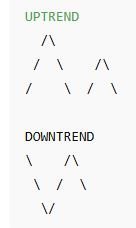
Trend is your engine.
2️⃣ Breakout from Tight Consolidation
Price builds pressure →
then explodes →
Gamma expands →
Premium shoots up fast.
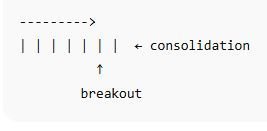
Buyers thrive here.
3️⃣ Low to Medium IV
Low IV means:
- premiums are cheaper
- Vega is low
- future expansion possible
Avoid buying in high IV — you’ll get IV crushed.
4️⃣ Strong Volume Confirmation
Volume = conviction.
Breakout + volume = powerful moves.
5️⃣ Support or Resistance Breaks
When price breaks an institutional level:
- Stoploss hunts
- Liquidity sweeps
- Momentum acceleration
→ Perfect for buyers.
When NOT to Buy (This Saves You More Money Than Anything Else)
Option buyers MUST avoid these conditions:
❌ 1. Sideways Market
Sideways market = death for premium.
You lose:
- Theta
- Gamma
- Vega
- Patience
- Premium
—- —- —-
| | | |
—- —- —- (flat zone)
Avoid.
❌ 2. High IV Conditions
High IV before:
- events
- news
- big announcements
Premium is inflated.
Post-event → IV crashes.
Your premium collapses even if direction is correct.
❌ 3. Buying Deep OTM
Deep OTM = low Delta
= premium barely moves
= maximum decay
= highest probability of zero
Avoid unless scalping with precision.
❌ 4. Buying Late in Expiry Week (Wednesday/Thursday)
Theta kills aggressively.
ATM options lose 30–70% value in hours.
❌ 5. Buying Against Trend (The Ego Trade)
If NIFTY is trending up…
DO NOT buy puts hoping for a top.
You are fighting big players.
Which Strike to Buy? (The Delta Rule)
This is the professional rule:
**Ideal Strikes for Option Buyers:
ATM or Slight ITM**
WHY?
Because these strikes have:
- Medium to high Delta
- Good speed
- Reasonable cost
- Fast gamma expansion
- Better stability
- Less time decay impact
✔ ATM Delta ≈ 0.5
✔ ITM Delta ≈ 0.6 to 0.7
This is the golden range.
Strike Comparison — Which One Wins?
Let’s compare 3 call options when price rises 100 points:
- ITM (Delta 0.65)
Moves ≈ 65 points → Best reaction
More expensive but reliable.
- ATM (Delta 0.50)
Moves ≈ 50 points → Good reaction
Perfect for momentum.
- OTM (Delta 0.25)
Moves ≈ 25 points → Slow
Often disappointing.
ITM: ██████████████ (fast)
ATM: ████████ (medium)
OTM: ███ (slow)
Buying ITM/ATM is a superpower.
Entry Rules for Option Buying (Institutional Framework)
Here is the step-by-step professional entry checklist:
✔ Step 1: Identify market trend
Trend = engine.
✔ Step 2: Confirm breakout or breakdown
Structure first.
✔ Step 3: Check OI shift
OI increase on puts → bullish
OI increase on calls → bearish
✔ Step 4: Confirm IV is low/medium
Premium must be fairly priced.
✔ Step 5: Choose ATM or ITM strike
Delta= 0.50–0.65 is ideal.
✔ Step 6: Enter only after confirmation candle
Avoid impulsiveness.
✔ Step 7: Place stoploss (25–35% of premium)
Non-negotiable.
✔ Step 8: Exit on reversal candle
Do NOT wait for losses to grow.
This is how professionals buy options.
Exit Rules (The Mature Part That Beginners Reject)
✔ Exit Rule 1: Book profits at 30–60% gain
This protects from reversals.
✔ Exit Rule 2: Trail stoploss once premium doubles
Lock in profits.
✔ Exit Rule 3: Exit if trend weakens
Trend is your fuel.
Fuel gone = exit.
✔ Exit Rule 4: Exit before big events
Avoid IV crush.
✔ Exit Rule 5: Do NOT hold for “big move dreams”
Take what the market gives.
Buying Calls — Real Example (Simple but Powerful)
NIFTY = 20,000
Price breaks 20,050 resistance with high volume.
You buy:
20,000 CE @ ₹120
- Delta = 0.48
- IV = medium
- Trend strong
- OI shows put writing at 20,000
Within 25 minutes,
NIFTY hits 20,120.
Premium = ₹185
Exit at +65 (54% profit).
Clear, logical, repeatable.
Buying Puts — Crash Example
NIFTY = 20,000
Breaks support at 19,960
OI shows call buildup
IV rising
Volume expanding
Buy:
20,000 PE @ ₹110
NIFTY drops to 19,880
Premium jumps to ₹210
Exit with +100 (91% profit)
No guesswork.
Pure structure.
Buying on Breakouts — Example
Resistance: 20050
▲
candle breakout
▲
Buy CE
After breakout:
Strong volume
High momentum
Clean direction
Option buyer’s favorite.
Why Beginners Fail at Option Buying (Truth Bomb)
❌ They buy deep OTM
Premium doesn’t move.
❌ They buy in sideways market
Premium decays.
❌ They buy just before event
IV crush hits.
❌ They don’t understand Delta
Slow premium.
❌ They hold losers
Hoping for a miracle.
❌ They don’t follow trend
Fight the market.
❌ They buy too late
After most of the move is over.
❌ They don’t exit
Wait until premium becomes 0.
Option buying is NOT for gamblers.
It’s for traders who follow rules.
The 3 Best Setups for Option Buyers (Institutional Quality)
✔ Setup 1: Breakout + High Volume + Low IV
The premium explodes.
✔ Setup 2: Trend Continuation Pullback
Pullback enters support →
Bounce →
Enter with call (or put).
✔ Setup 3: OI Shift in Your Direction
Put OI buildup → bullish
Call OI buildup → bearish
This confirms momentum.
The Golden Rule of Option Buying
Buy only when the market MUST move.
Not “should” move.
Not “might” move.
Not “probably” move.
It must move — due to:
- breakout
- breakdown
- strong trend
- sudden OI shift
- volume burst
- structure change
If movement is uncertain, DO NOT buy.
Chapter Summary
You now understand:
- When to buy
- When NOT to buy
- Which strike to choose
- Why ATM/ITM is better
- How to use Delta
- How IV impacts buying
- How OI confirms direction
- How to enter properly
- How to exit safely
- Why beginners lose
- How to avoid traps
- Best setups
- Risk control
- Trend logic
This chapter gives you the complete blueprint for successful option buying.
From here, you are ready to learn the other side of the game:
Option Selling — where consistency and income truly come from.
⭐ CHAPTER 8 – OPTION SELLING MASTERY
The Probability Game, Time Decay Advantage & Safe Hedged Selling Techniques
Why This Chapter Matters (The Hard Truth of the Market)
The market is brutally simple:
**Option Buyers dream.
Option Sellers earn.**
Why?
Because:
- Buyers need to be RIGHT in direction + time + speed
- Sellers only need the market to not make a huge move
- Buyers fight Greeks
- Sellers profit from Greeks
- Buyers need miracles
- Sellers rely on probability and math
In fact:
**70–80% of options expire worthless.
Which means 70–80% of the time → SELLERS WIN.**
This chapter shows you why.
But we will not promote dangerous naked selling.
Everything will be taught safely, with hedges.
The Core Philosophy of Option Selling
Professionals don’t predict. They position.
Option buyers must predict:
- Up?
- Down?
- When?
- How fast?
- How big?
But option sellers do NOT predict direction.
They bet on:
- Slow market
- Sideways market
- Controlled moves
- Probability
- Time decay
- IV crush
- Range-bound behavior
Professionals sell based on statistics, not guesses.
The Mathematical Edge of Selling Options
Let’s break it down in simple logic.
When you buy an option:
- Theta hurts you
- IV crush hurts you
- Wrong timing hurts you
- Wrong direction hurts you
- Slow movement hurts you
- Sideways hurts you
- Reversal hurts you
When you sell an option:
- Theta helps you
- IV crush helps you
- Slow movement helps you
- Sideways helps you
- Small movements help you
- Time helps you
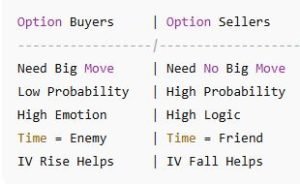
This is why professional traders make consistent returns selling options.
Why Option Selling Works (The 5 Laws of Probability)
Think of it like insurance.
✔ Law 1: Most days are NOT big-trend days
Indices trend big only 10–20% of days.
✔ Law 2: Markets stay in ranges most of the time
Perfect for sellers.
✔ Law 3: Time decay works 24/7
Sellers get paid even when nothing happens.
✔ Law 4: IV crush after events always rewards sellers
Finance 101.
✔ Law 5: Institutions hedge professionally
They sell with structure.
Not naked gambling.
Who Should Sell Options? (The Honest Answer)
Option selling is ideal for:
- disciplined traders
- risk managers
- traders with structure
- traders who follow rules
- traders who want consistent income
- not jackpot hunters
Selling is not for people who:
- refuse hedges
- want quick excitement
- can’t take slow profits
- don’t control emotions
This chapter teaches the safe, hedged way of selling.
Why Hedging Is Mandatory (The Difference Between Pro & Amateur)
UNHEDGED = Unlimited risk
A single black-swan event → account gone.
HEDGED = Limited risk
Risk is capped.
Margin is lower.
Peace of mind is high.
Institutions ALWAYS hedge.
Unhedged : Risk → ∞
Hedged : Risk → Limited
In this guide, we ONLY teach hedged selling.
The Time Decay Engine (Why Sellers Earn Even During Sleep)
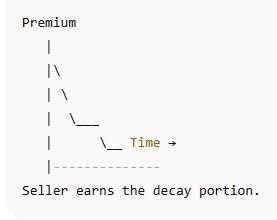
Theta decay is the money-printing engine for sellers.
Theta Example
If Theta = 10,
seller earns ₹10 per day IF price stays within range.
Over weekends:
- Saturday + Sunday decay applied
- Seller earns 2 days of decay instantly
When Should You Sell Options? (The Professional Conditions)
Option sellers MUST follow these 8 conditions:
1️⃣ When IV Is High
Inflated premiums → better selling price.
2️⃣ When Market Is Range-Bound
Sideways markets are seller heaven.
3️⃣ When Volume is Stable
Low volatility helps seller positions stay safe.
4️⃣ After Major Events
Budget → results → election → Fed
IV collapses. Perfect for sellers.
5️⃣ When PCR ≈ 1
Neutral sentiment → sideways move expected.
6️⃣ When Strong Support & Resistance Exists
Sell above resistance.
Sell below support.
7️⃣ In Expiry Week (Safely)
Time decay accelerates.
Premium dies fast.
8️⃣ When You Have Hedges
Never sell naked.
The Safe Selling Rule: “Sell Where Market Will NOT Go”
Professional sellers think this way:
“Where will the market NOT go today?”
NOT where it will go.
This is the core mindset.
Example:
- Strong support at 19,800
- Strong resistance at 20,200
Sell:
- 20,300 CE
- 19,700 PE
Because probability of touching these is low.
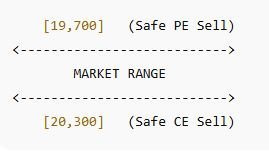
This is where consistency is born.
The Three Master Selling Strategies (Beginner to Pro)
We will now break down:
- Credit Spreads
- Iron Condor
- Iron Fly
All hedged and safe.
Strategy 1: Credit Spread (The Safest Option Selling Method)
A credit spread =
Sell an option + Buy further OTM option for protection.
Example:
- Sell 20,200 CE @ ₹80
- Buy 20,300 CE @ ₹40
Net credit = ₹40
Max risk = (difference in strikes – credit) = 100 – 40 = ₹60
Why this is safe:
- Risk is limited
- Margin is low
- Trend reversal won’t kill you
- Night gaps are safe
- Black swan protected
payoff:

Credit spreads are perfect for beginners.
Strategy 2: Iron Condor (Sideways Income Machine)
Iron condor =
Sell OTM call
Sell OTM put
Buy further OTM call
Buy further OTM put
Structure:
Sell CE (OTM)
Buy CE (far OTM)
Sell PE (OTM)
Buy PE (far OTM)
This profits when market stays in a range.
payoff:

Best used when:
- IV high
- Market sideways
- Strong support/resistance exists
Perfect for weekly income.
Strategy 3: Iron Fly (Expiry Professional Setup)
Sell ATM straddle + hedge both sides:
- Sell ATM CE
- Sell ATM PE
- Buy higher CE
- Buy lower PE
Narrow range but HIGH reward.
Used by professional expiry traders.
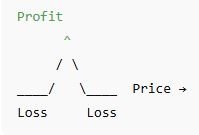
Higher risk than condor, but highly profitable during consolidation.
The Five Deadly Mistakes of Sellers (Avoid These!)
❌ 1. Naked Selling
Unlimited risk.
❌ 2. Selling too close to spot
Easy to get hit.
❌ 3. Selling during low IV
Premium too small.
❌ 4. Selling without checking OI
Bad levels.
❌ 5. Holding losing trades too long
Adjust early, adjust small.
Adjustments — The Professional Skill
Professionals adjust positions, not hold blindly.
For CE side hit:
Roll call spreads upward.
For PE side hit:
Roll put spreads downward.
Adjustments reduce:
- loss
- stress
- volatility risk
This is how institutions stay consistent.
How Dhan Helps Option Sellers (Practical Advantage)
Dhan’s options platform is very friendly for selling:
✔ One-click spreads & condors
✔ Margin calculator built-in
✔ IV charts
✔ OI heatmaps
✔ Fast execution
✔ Visual payoff diagrams
✔ Auto-hedged structure builder
✔ Premium alerts
✔ Strategy Greeks display
A perfect environment for safe, systematic selling.
If you’re looking for a modern, feature-rich, and trader-friendly platform, Dhan is easily one of the best choices available today. From zero account opening charges to advanced tools like native TradingView, options strategy builder, and free API access, Dhan is clearly built with the modern Indian trader in mind.
With Dhan you can also invest and trade in IPO’s, NFO’s, SIP, Bonds, ETF, SGB, and many other financial products with so much ease.
Whether you’re an intraday trader, an options strategist, or a long-term investor, Dhan offers the perfect blend of speed, simplicity, and smart technology — without burning a hole in your pocket.
Why wait? Open your Dhan account now and take control of your trading journey with confidence.
👉 Click here to get started with Dhan
Open a Free Dhan Trading & Demat Account
Dhan offers cutting-edge tools for fast, powerful, and informed trading:
- ✅ Zero brokerage on delivery trades
- ✅ Auto-detection of candlestick patterns on charts
- ✅ Advanced Option Chain with Greeks, Max Pain, PCR & more
- ✅ Pre-built & custom Option Strategy Builder (Free)
- ✅ 20 Depth Market Data and Flash Trade execution
- ✅ Margin Trading Facility (MTF) with 4X leverage (75%)
- ✅ 3 Platforms: Mobile App, Web App & Dedicated Options App
- ✅ ScanX Screener: stock insights, trends & news
- ✅ Advanced orders: Trailing SL, Iceberg, Forever Orders
- ✅ Instantly pledge 1,500+ stocks for options margin
- ✅ Trade commodities: Gold, Silver, Crude, Natural Gas
- ✅ Fundamental + Technical analysis across all platforms
No paperwork. Zero account opening charges. Setup in minutes.
Chapter Summary
You now master:
- Why selling works
- Why sellers earn consistently
- Time decay advantage
- IV crush advantage
- Safe selling conditions
- Credit spreads
- Iron condor
- Iron fly
- Risk management
- Adjustments
- Professional mindset
- Seller psychology
This chapter turns a beginner into a professional-style income trader.
You now understand:
**Option Buying = engine
Option Selling = stabilizer**
Both are needed at different times.
⭐ CHAPTER 9 – THE 17 MOST COMMON BEGINNER MISTAKES
(And How to Avoid Every Single One of Them)
Why This Chapter Is a Turning Point
Options trading is NOT difficult.
But beginners make it difficult by:
- choosing wrong strikes
- buying at wrong times
- selling at wrong times
- ignoring Greeks
- ignoring IV
- misunderstanding OI
- mistiming entries
- mismanaging exits
- overtrading
- ego trading
- gambling with deep OTM
- refusing hedges
This chapter acts as a mirror.
It shows everything beginners do wrong…
and teaches the exact fix.
By the end, you’ll trade with the clarity of a professional.
Let’s go.
⭐ BEGINNER MISTAKE #1
Buying Deep OTM Options (The Lottery Addiction)
Beginners see:
- CE at ₹5
- PE at ₹8
- CE at ₹3
- PE at ₹2
And think:
“When this becomes 50 rupees, I will be rich.”
But they don’t understand:
- Delta is too low
- Movement is too slow
- Time decay is very fast
- Probability is extremely low
Deep OTM is NOT a trade.
It is a lottery ticket.
✔ FIX:
Buy ATM or slight ITM only.
⭐ MISTAKE #2
Buying in Sideways Markets
Beginners think:
“Market toh upar neeche hota hi rahta hai… let me buy.”
Wrong.
Sideways market =
Theta massacre + Delta stagnation = Premium collapse
—- —- —-
| | | |
—- —- —-
Premium dies.
✔ FIX:
Buy only when:
- Breakout
- Breakdown
- Trend continuation
- High volume expansion
⭐ MISTAKE #3
Buying in High IV (Just Before Events)
Events like:
- Budget
- Elections
- RBI meeting
- Fed meeting
- Earnings
inflate IV massively.
Premiums are heavy, fat, bloated.
After event → IV crush
Premium collapses even if direction is correct.
✔ FIX:
Do NOT buy options before major events.
Buy AFTER event when IV drops.
⭐ MISTAKE #4
Not Understanding Greeks
Beginners trade “naked”:
- No Delta understanding
- No Gamma awareness
- No Theta knowledge
- No Vega caution
- No IV logic
This is like driving without brakes or mirrors.
✔ FIX:
Use the Greek cheat-sheet:
- Buyers → Focus on Delta & Gamma
- Sellers → Focus on Theta & Vega
⭐ MISTAKE #5
Choosing Wrong Strikes
Beginners love:
- Deep OTM (cheap, but useless)
- Too narrow ITM (slow, expensive)
- Far ATM or random picks
✔ FIX:
Follow the Delta rule:
- Buy → Delta 0.50–0.65
- Sell → Delta 0.15–0.25
Professionals ALWAYS use this.
⭐ MISTAKE #6
Averaging Losing Options
This is suicide.
If premium falls from ₹120 → ₹80 → ₹40 → ₹20 → ₹5
DO NOT average.
Options decay fast.
Averaging accelerates the loss.
✔ FIX:
Set a hard stoploss (25–35% of premium).
Exit instantly.
NEVER average losers.
⭐ MISTAKE #7
Buying Too Late (After Most of the Move Happened)
Beginners join AFTER momentum is over.
They buy at the top.
Then premium collapses on normal pullback.
✔ FIX:
Enter early in the trend:
- On breakout
- On breakout retest
- On structure change
- When volume appears
- When OI shifts
⭐ MISTAKE #8
Holding Losing Trades Hoping for a Miracle
The market doesn’t care about hope.
If structure breaks:
GET OUT.
Options require small, quick, mechanical decisions.
✔ FIX:
Set one exit rule:
“If the candle closes against my direction → EXIT.”
⭐ MISTAKE #9
No Stoploss for Option Buying
Premium can collapse 40–70% in minutes.
Without stoploss you will:
- wipe capital
- lose discipline
- lose confidence
- hate trading
✔ FIX:
Use a stoploss ALWAYS:
- Fixed % (25–35%)
- Or based on structure
- Or based on points
⭐ MISTAKE #10
Overtrading (The Emotional Spiral)
Beginners think:
- “One more trade.”
- “I’ll recover this loss now.”
- “Almost reached target.”
- “Aaj toh market de hi dega.”
Overtrading turns winners into losers.
✔ FIX:
MAX 2–3 trades per day.
MAX 1 expiry trade.
Stop after major win or major loss.
⭐ MISTAKE #11
Trading Against Trend (Ego Trading)
Beginners short in uptrend.
Buy calls in downtrend.
Hope for reversals.
This is ego, not trading.
✔ FIX:
Follow the structure:
- Higher highs & lows → Calls only
- Lower highs & lows → Puts only
- Sideways → No buying
⭐ MISTAKE #12
Not Understanding OI (Open Interest)
Beginners ignore OI.
Professionals check:
- Put OI for support
- Call OI for resistance
- OI buildup for direction
- OI exit for reversals
✔ FIX:
Use Option Chain every day:
- High Put OI → Support
- High Call OI → Resistance
- Both high → Sideways
⭐ MISTAKE #13
Holding Options Till Expiry (Dangerous)
Theta explodes.
Gamma creates whipsaws.
Premium collapses unexpectedly.
✔ FIX:
If you’re a beginner:
- Do NOT buy options on expiry
- Do NOT hold till the last hour
- Do NOT expect miracles
⭐ MISTAKE #14
Selling Without Hedge (Unlimited Risk)
Unhedged selling =
One black-swan → Account gone.
Professionals NEVER do this.
✔ FIX:
Use hedges:
- Credit spreads
- Iron condors
- Iron flies
Always limited risk.
Lower margin.
Low stress.
⭐ MISTAKE #15
Entering Without Confirmation
Beginners enter:
- in anticipation
- in hope
- without structure
- without trend
- without breakout
- without volume
✔ FIX:
Before entering, ask:
“Is the market forced to move right now?”
If answer is NO → do NOT trade.
⭐ MISTAKE #16
No Exit Plan
Beginners have no clarity on:
- When to book profit
- When to exit loss
- When to cut quickly
- When to trail
- When to stay
- When to walk away
✔ FIX:
Use this simple rule:
**BOOK PARTIAL profits at 30–40%
BOOK FULL profits at 60–80%**
And:
Exit losers at –25% stoploss
⭐ MISTAKE #17
Trading Without Position Sizing
Beginners trade with:
- random lot sizes
- emotional doubling
- revenge front-loading
This destroys capital.
✔ FIX:
Use fixed position sizing:
- Buy: 1–2 lots
- Sell spreads: 1 lot per setup
- Keep buffer money aside
Consistency > aggression.
⭐ BEGINNER TRANSFORMATION CHECKLIST (Everything in 30 seconds)
❌ Don’t buy deep OTM
❌ Don’t buy in high IV
❌ Don’t trade sideways
❌ Don’t trade without stoploss
❌ Don’t average losers
❌ Don’t overtrade
❌ Don’t predict tops/bottoms
❌ Don’t sell naked
❌ Don’t fight trend
✔ Buy ATM/ITM
✔ Buy in low IV
✔ Sell in high IV
✔ Sell using hedges
✔ Follow Delta rules
✔ Use OI for structure
✔ Set stoploss always
✔ Enter with confirmation only
✔ Follow 2–3 trades/day rule
If you follow this checklist, your accuracy and consistency will jump significantly.
⭐ CHAPTER 10 – ENTRY, EXIT & TRADE MANAGEMENT MASTERY
The Complete Professional Rulebook for Options Traders
Why This Chapter Changes Everything
You can have:
- the perfect analysis
- perfect strike selection
- perfect breakout level
- perfect understanding of Greeks
- perfect direction prediction
…and STILL lose money if your entries and exits are weak.
This chapter teaches the MOST important skill of all:
How to execute a trade like a professional trader.
This includes:
- When exactly to enter
- When NOT to enter
- Understanding confirmation
- Placement of stoploss
- How to exit safely
- How to trail cleverly
- How to avoid entry traps
- When not to trade at all
Most traders don’t lose because of analysis.
They lose because they enter late, exit early, hold losers, and mismanage winners.
After this chapter, you will NOT be that trader.
Let’s begin.
Understanding the 3 Phases of a Trade
Every trade has 3 phases:
Phase 1 — Pre-Entry (The Analysis Phase)
Trend, OI, IV, structure, volatility.
Phase 2 — Entry (The Confirmation Phase)
Where do you place your order?
Phase 3 — Post-Entry (The Management Phase)
SL handling, trailing, exiting, adjusting.
Most beginners only use:
- Phase 1 (half-hearted)
- Phase 2 (impulsive)
And completely ignore Phase 3.
Professionals master all three.
The Exact Moments When Professionals Enter Trades
Professionals ONLY enter at specific moments:
1️⃣ Trend Continuation Entry
(Higher lows in uptrend / lower highs in downtrend)

2️⃣ Breakout Entry with Retest
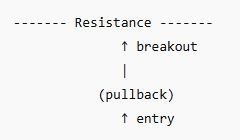
3️⃣ Breakdown Entry with Pullback
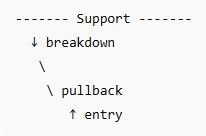
4️⃣ Volume Expansion Entry
When breakout candle has:
- Long body
- High volume
- OI confirmation
Premium explodes quickly.
5️⃣ IV Expansion Entry (For Buyers Only)
If IV is starting to rise
(panic, sudden movement, breakout, big candle)
Premiums inflate fast.
The 4 Entry Types You Must Avoid (Beginners Fail Here)
❌ 1. Entering After Big Candle (Too Late)
If the large candle has already formed,
risk-reward becomes terrible
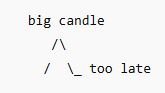
Entering in Sideways Zones
Premium dies quickly.
—- —- —-
| | | |
—- —- —-
❌ 3. Entering Without Confirmation
Impulse is NOT a strategy.
❌ 4. Entering Right Before News
News → IV spike → then IV crush.
You get destroyed.
⭐ 10.4 The Perfect Entry Framework (8-Point System)
Before entering, ask:
- Is trend clear?
- Is structure in my direction?
- Is volume confirming?
- Is OI supporting direction?
- Is IV low/medium for buying?
- Is premium fairly priced?
- Are there no major news events?
- Is the candle a confirmation candle?
If ALL 8 are “YES” → ENTER.
If even 1 is NO → WAIT.
Patience saves accounts.
Professional Entry Timing (The Candle Logic)
There are ONLY 3 true entry candles:
1️⃣ Breakout Candle
Big-bodied green/unred candle blasting through resistance/support.
2️⃣ Retest Candle
Small rejection candle at breakout level
3️⃣ Trend Continuation Candle
Hammer, bullish engulfing, inverted hammer (in downtrend), etc.
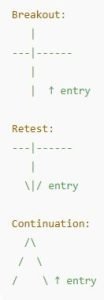
These 3 entries are the backbone of professional trading.
The Perfect Stoploss Technique
Stoploss is NOT:
- arbitrary
- emotional
- random
Stoploss is structure-based.
**STOPLOSS MUST BE PLACED BELOW STRUCTURE (for CE)
and ABOVE STRUCTURE (for PE).**
Example for CE:
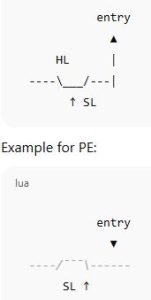
Never place SL based on:
- “I feel like it”
- round numbers
- percentage only
Structure FIRST → Percent SECOND.
Stoploss Size Rules (Institutional Logic)
📌 For Option Buyers:
Stoploss = 25–35% of premium
If premium = ₹100 → SL between 25–35.
📌 For Spread Traders:
Stoploss = level-based, not premium-based.
📌 For Sellers:
SL based on breach of range, not premium.
The Real Reason Your SL Hits (Without You Realizing Why)
Beginners get SL hit because:
- They enter late
- They buy OTM
- They enter at resistance for calls
- They enter at support for puts
- They ignore volume
- They ignore OI
- They trade during chop
- They enter before news
- They enter against the trend
This chapter fixes all of these.
How to Exit Like a Professional
Professionals exit using 5 rules:
✔ 1. Target Exit at 30–60% Profit
Take profits.
Do NOT hold for greed.
30–40% → partial exit
60–80% → full exit
✔ 2. Exit on Reversal Candle
Small reversal candle → exit 50%
Big reversal candle → exit 100%
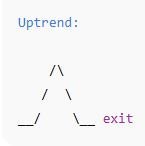
✔ 3. Exit if Delta collapses (for buyers)
OTM → ATM? Good
ATM → OTM? Exit
Delta falling = momentum lost.
✔ 4. Exit before major news
Never carry position into:
- events
- announcements
- results
- speeches
✔ 5. Time-based exit
If trade doesn’t move for 10–15 minutes (intraday), EXIT.
Theta + slippage will kill you.
The Trailing Stoploss Method (TSL)
Professionals trail SL this way:
✔ Step 1: Once premium doubles → Trail cost to cost.
✔ Step 2: Once premium +50% → Trail SL to 20% profit.
✔ Step 3: Once premium +100% → Trail below last swing.
This locks in gains.
Professional Position Sizing (The Pillar of Survival)
📌 Never risk more than 1–2% of capital per trade.
If capital = ₹1,00,000 →
Risk = ₹1,000–₹2,000
This ensures survivability.
The 4 Best Trade Management Rules All Pros Use
✔ Rule 1: “If trade doesn’t move fast, exit fast.”
Buyers need SPEED.
✔ Rule 2: “If SL hits, stop for the day.”
No revenge.
✔ Rule 3: “If you hit target early, reduce size or stop.”
Protect profits.
✔ Rule 4: “If conditions change, adjust or exit.”
Market first, ego second.
The 2-Minute Trade Evaluation Checklist
After entering:
Is price respecting structure?
Is volume flowing?
Is OI confirming?
Is SL safe?
Is trend strong?
Are candles in my direction?
If 2 or more answers become “NO” → EXIT.
The 3 Situations Where You MUST Exit Immediately
🚨 1. Opposite breakout
Support breaks (for CE) → exit
Resistance breaks (for PE) → exit
🚨 2. High volume opposite candle
Institutions reversing direction.
🚨 3. Large IV drop (for buyers)
Premium collapses → exit instantly.
The “10 Commandments” of Pro Trade Execution
- Trade only with trend.
- Enter only on confirmation.
- SL based only on structure.
- Buy only ATM/ITM.
- Sell only OTM with hedge.
- Never hold losers.
- Never average down.
- Use fixed position sizing.
- Don’t predict, react.
- Respect the market always.
Follow these and you trade like a professional.
Chapter Summary
You now understand:
- The 3 phases of a trade
- Perfect entry points
- Avoiding false entries
- Candle-based logic
- Trend-confirmation logic
- Stoploss placement
- Trailing rules
- When to take profit
- When to exit losers
- Position sizing
- Trade timing
- Professional management rules
This chapter transforms a beginner into a rule-based, disciplined, structured trader.
From here you are ready to learn:
Risk management, psychology, and building your full trading blueprint.
That’s next.
⭐ CHAPTER 11 – RISK MANAGEMENT MASTERY
The Rules That Save Your Capital, Confidence & Longevity
Read This Slowly (It Is the Truth About Trading)
Most traders think:
- Better strategy = more profit
- More indicators = more accuracy
- More trades = more opportunities
- More risk = more gain
But professionals know:
**Better RISK management = more survival
which = more time in the game
which = more profit.**
The people who win in trading are not the smartest.
They are the ones who:
- survive longer
- control risk
- manage position sizes
- avoid stupid losses
This chapter teaches you the rules that keep you alive, consistent, and confident.
Let’s begin.
The 3 Pillars of Risk Management
Professional risk management rests on only 3 pillars:
Pillar 1 → Loss Limitation (How much you lose)
Pillar 2 → Position Sizing (How big you go)
Pillar 3 → Survival & Consistency (How long you stay)
If you master these,
you automatically outperform 95% of traders.
The “1–2% Risk Rule” — The Law of Longevity
This is the first rule of professional trading:
Never risk more than 1–2% of your capital on ANY single trade.
If capital = ₹1,00,000
Your maximum risk = ₹1,000–₹2,000
This rule alone prevents:
- emotional trading
- revenge trading
- blowups
- account destruction
Capital = 100%
Risk per Trade = 1–2%
Trades Needed to Blow Up = Impossible
The goal is to stay in the game long enough to grow, not gamble.
The 3 Parts of Risk in an Options Trade
Options have three types of risk:
✔ 1. Directional Risk
Price moving against you.
✔ 2. Time Risk
Theta decay killing premium.
✔ 3. Volatility Risk
IV rising or collapsing suddenly.
Most beginners only think about direction.
Pros think about all three.
Risk Rule for Option Buyers
Option buyers lose the most because:
- they enter with no plan
- they enter too large
- they chase trades
- they hold losers
- they don’t respect time decay
Here are the pro rules:
Rule A — Buy with Small Capital (1–2 lots max)
Buying is volatile.
Your position must be small.
Rule B — Use Hard Stoploss (25–35% of premium)
If premium = ₹100
SL = ₹25–₹35
No negotiation.
Rule C — Enter only when momentum is strong
Weak entry = maximum SL hit.
Rule D — Exit if trade doesn’t move in 10–15 minutes
Sideways = decay.
Rule E — Never revenge trade after a hit
One revenge trade can destroy 10 good trades.
Option buying is high-reward but high-risk.
Position size must be small.
Risk Rule for Option Sellers
Option selling offers:
- high probability
- income
- stability
- time advantage
But ONLY when done safely.
Professional selling rules:
Rule A — NEVER Sell Naked (Unhedged)
Naked selling = unlimited loss.
One unexpected candle → account wipeout.
Rule B — Use Credit Spreads, Condors, Flies
These cap risk and lower margin.
Rule C — Don’t Sell Strikes Too Close to Spot
Choose strikes WITH DISTANCE:
- Delta 0.15–0.25
- Logical levels
- Based on OI barriers
Rule D — Avoid Selling in Low IV
Low IV = cheap premium = bad selling conditions.
Rule E — Exit Early if Market Trend Changes
Sellers must be flexible.
Rule F — Size Large Only When Hedged
Sellers can scale positions ONLY when hedged.
The 4-Step Risk Formula (Used by Professionals)
Professional traders calculate risk with this exact formula:
R = (Entry Premium – Stoploss Premium) × Lots
Before every trade, calculate R.
If R > 1.5% of capital → skip trade.
This prevents emotional entries.
Risk-Reward Ratio (RRR) — The Mathematical Backbone
Professional traders target minimum:
RRR = 1:2
(Risk 1 unit, aim to gain 2+ units)
High accuracy is NOT required.
If your risk-reward is strong, accuracy becomes less important.
Loss: -1
Loss: -1
Gain: +2
Gain: +2
Gain: +2
Net = +4
Even with 40% accuracy you’re profitable.
The 5 Deadly Psychological Risks (Internal Risks)
Risk isn’t only about numbers.
The biggest risks are psychological:
❌ Risk 1: Overconfidence
Wins make you take oversized trades.
❌ Risk 2: Fear
Stops you from entering the best setups.
❌ Risk 3: Revenge
Destroys accounts quickly.
❌ Risk 4: Greed
You don’t exit early enough, profit becomes loss.
❌ Risk 5: FOMO
Chasing late trades = poor entries.
✔ FIX:
Write this rule on top of your monitor:
“Trade the plan, not the emotion.”
Capital Allocation Framework (How Pros Divide Money)
Professional traders divide capital into buckets:
✔ 60% — Selling (low risk, hedged income)
✔ 20% — Buying (high reward, small size)
✔ 10% — Event / Swing trades
✔ 10% — Cash buffer for safety
This creates a stable, diversified risk approach.
Daily Risk Management Rules (Simple but Life-Saving)
Professionals follow a few simple rules:
✔ Rule 1: MAX 2 losing trades per day
Stop trading after 2 losses.
✔ Rule 2: MAX 2–3 trades/day
Prevents overtrading.
✔ Rule 3: If first trade is a big win → reduce size
Protect profits.
✔ Rule 4: No trading during emotional days
Sleep, rest, reset.
✔ Rule 5: No trading with borrowed money
Trading with pressure is deadly.
Understanding Drawdowns (The Reality of Trading)
Drawdown =
A period where your capital reduces.
Every trader faces drawdowns.
Professionals:
- reduce size
- trade slow
- trade defensively
- preserve capital
Beginners:
- increase size
- revenge trade
- force trades
- blow up accounts
Risk management PREVENTS catastrophic drawdowns.
The 7 Golden Risk Rules (Institutional Wisdom)
- Risk < 2% per trade
- SL mandatory
- Position size fixed
- No naked selling
- Exit fast, exit early
- Reduce size during volatility
- Avoid revenge trading
These rules build trading careers.
Breaking these rules destroys trading careers.
The “Stability Over Victory” Philosophy
Professionals don’t aim to:
- win every day
- win every trade
- catch every move
Professionals aim to:
- protect capital
- stay in the game
- trade consistently
- avoid stupid mistakes
- preserve emotional energy
That’s why they earn.
Chapter Summary
You now understand:
- The 1–2% rule
- Stoploss logic
- Position sizing
- Risk formulas
- Psychology risks
- Capital division
- Seller-specific rules
- Buyer-specific rules
- When to exit
- When to stop trading
- Drawdown logic
- The 7 Golden Rules
Risk management is what turns:
- amateurs into professionals
- hopeful traders into consistent traders
- volatile P&L into stable P&L
This chapter builds the foundation of trading longevity.
⭐ CHAPTER 12 – TRADING PSYCHOLOGY MASTERY
Controlling Fear, Greed, FOMO & Emotional Traps
The Reality No One Talks About
Most traders think they have:
- strategy problems
- indicator problems
- entry problems
- exit problems
But in reality,
they have psychology problems.
Because markets do NOT test your strategy.
Markets test:
- your discipline
- your patience
- your emotional control
- your ability to endure uncertainty
- your resilience
- your confidence
- your ability to follow your own rules
The biggest enemy is not volatility.
The biggest enemy is not option Greeks.
The biggest enemy is not OI traps.
The biggest enemy is:
Your own brain under stress.
This chapter rewires it.
The 3 Brains of a Trader (The Neuroscience Behind Trading Decisions)
Humans operate with 3 “brains”:
1️⃣ The Survival Brain (Fear Brain)
Located in the amygdala.
Its job is:
- avoid pain
- avoid danger
- avoid uncertainty
This is why:
- you exit too early
- you hesitate to enter
- you panic when premium drops
- you freeze when market turns
Your survival brain hates trading.
2️⃣ The Reward Brain (Greed Brain)
Located in dopamine circuits.
Its job is:
- chase excitement
- chase big profits
- gamble
- chase late breakouts
- avoid missing moves
This is why you:
- overtrade
- hold winners too long
- chase entries
- buy deep OTM
Your reward brain loves gambling.
3️⃣ The Logical Brain (The Trader Brain)
Located in the prefrontal cortex.
Its job is:
- follow the plan
- execute rules
- use discipline
- use statistics
- stay calm
This is the brain that executes trading logic.
The GOAL of psychology is simple:
Deactivate fear brain
Silence greed brain
Operate from logical brain
Let’s learn how.
Why Fear Happens (And How to Fix It)
Fear happens because your brain sees trading as a threat:
- losing money
- being wrong
- looking stupid
- missing out
- uncertainty
Fear creates:
- hesitation at perfect entries
- early exits
- panic SL triggers
- inability to reenter
To fix fear:
✔ Reduce position size
✔ Use fixed stoploss
✔ Have a rule-based system
✔ Trade with high-probability setups
Fear disappears when risk is controlled.
Why Greed Happens (And How to Fix It)
Greed comes from:
- wanting big wins
- wanting to make money fast
- wanting to recover losses
- overestimating ability
Greed destroys:
- risk management
- stoploss discipline
- patience
- profit-taking logic
✔ FIX:
Take profits at 30%–60%.
Follow exit rules from Chapter 10.
Reduce size after big wins.
Greed fades when you PRE-DECIDE profit-taking.
Why FOMO Happens (And How Professionals Avoid It)
FOMO = Fear Of Missing Out.
You feel it when:
- the market is running
- a big candle forms
- premium jumps
- others made money
- you missed the first move
FOMO = terrible entries.
✔ FIX:
Use the 3-candle rule:
“If the move already had 3 strong candles,
do NOT enter. The move is old.”
Professionals don’t chase.
They wait for pullbacks.
Why Revenge Trading Happens
Revenge trading is an emotional response to loss.
It comes from:
- ego
- anger
- frustration
- wanting to prove you’re right
- feeling left behind
Symptoms:
- doubling lot size
- entering random trades
- skipping rules
- massive losses
✔ FIX:
Use the Restart Rule:
“After any SL hit, take a 10-minute break.”
Revenge trades happen in the 10 minutes AFTER a loss.
Remove that zone → remove revenge.
The Psychology of Premature Exits (Killing Winners Early)
Why do beginners exit winners too early?
Because:
- they fear losing the small profit they see
- they have no trailing rule
- they don’t trust their strategy
- they watch the MTM too much
- they fear reversals
✔ FIX:
Follow fixed trailing rules:
- partial exit at +30%
- trail at +50–60%
- hold with stoploss moved to cost
This locks in gains.
The Psychology of Holding Losers Too Long
Beginners hold losers because:
- they don’t want to accept being wrong
- they hope market will reverse
- they treat losses like personal attacks
- they attach emotions to trades
But losses compound shockingly fast.
✔ FIX:
Use the 20–30% SL Rule
and never break it.
When loss is predetermined → emotions reduce.
Why You Break Your Own Trading Rules
Most people don’t break rules because they’re stupid.
They break rules because:
Their emotional brain takes over the logical brain.
This happens when:
- position size is too big
- you are on losing streak
- you are tired
- you are trading too frequently
- you didn’t plan the trade
To prevent this:
✔ Trade smaller
✔ Use a plan BEFORE entering
✔ Limit trades per day
✔ Avoid nights of low sleep
✔ Avoid trading when emotional
Professionals KNOW when NOT to trade.
The Confidence Cycle (The Most Important Concept)
Trading success follows this loop:
CONFIDENCE → EXECUTION → RESULTS → HIGHER CONFIDENCE
But beginners get stuck in the opposite cycle:
FEAR → HESITATION → BAD ENTRY → LOSS → MORE FEAR
This chapter breaks the negative cycle.
Your Trading Identity (Who You Believe You Are)
You must decide whether you are:
- a gambler
- a disciplined trader
- an amateur
- a professional
- a student
- a long-term player
Your identity determines your behavior.
You should adopt this identity:
“I am a rule-based trader who always follows the plan.”
Write it on top of your trade journal.
How Professionals Control Their Emotions
They use:
✔ checklists
✔ pre-decided rules
✔ position sizing
✔ trading windows
✔ cooldown periods
✔ daily limits
✔ mechanical exits
This reduces emotional load.
They don’t rely on willpower.
They rely on systems.
The Psychology of Sitting Out (The Most Underrated Skill)
Professionals know when NOT to trade.
They skip:
- overextended moves
- chop zones
- mid-range markets
- low-volume sessions
- volatile news periods
- random lunchtime trades
You don’t need to trade daily.
You need to trade properly.
Building a Psychological Fortress (Your Mental Framework)
Here are the 5 pillars:
✔ 1. Pre-Defined Rules
When the rules exist BEFORE the trade,
emotion cannot ruin it.
✔ 2. Outcome Independence
Focus on executing correctly,
not on the money.
✔ 3. Emotional Cooldown
After any SL → break for 10 minutes.
✔ 4. Trade Less, Trade Better
2–3 high-quality trades > 20 random ones.
✔ 5. Acceptance of Losses
Losses are part of the game.
Fear disappears when losses are accepted.
The 10 Psychological Affirmations You Must Adopt
- I follow my trading plan with discipline.
- I do not chase trades.
- I am comfortable taking small losses.
- I trade small, consistent, and calm.
- I trade what I see, not what I feel.
- I let winners run and cut losers fast.
- I do not compare myself to others.
- I trust my process and rules.
- I know that survival is more important than excitement.
- I control the trade; the trade does not control me.
Repeat these daily.
Chapter Summary
You now understand:
- fear brain
- greed brain
- logical trader brain
- early exits
- holding losers
- revenge trading
- FOMO entries
- greed psychology
- rule-breaking psychology
- emotional decision-making
- discipline frameworks
- professional mindset
- identity building
- confidence cycles
This chapter gives you the psychological backbone of a consistent, calm, professional trader.
You are now ready for the final technical chapters of this monster guide.
⭐ CHAPTER 13 – ADVANCED STRATEGIES MASTERCLASS
Spreads, Combo Trades, Trend Systems, and Professional Setups
Why This Chapter Is a Major Turning Point
Up to now:
- You learned theory
- You understood Greeks
- You mastered IV
- You understood OI and Option Chain
- You understood buying & selling
- You built psychology
- You formed execution discipline
Now we combine EVERYTHING into actual, repeatable, professional-grade strategies — the same methods used by:
- institutional traders
- volatility desk professionals
- market makers
- systematic options traders
- advanced retail traders
By the end of this chapter:
You will have plug-and-play systems you can use daily.
Why Advanced Strategies Are Necessary (The Institutional Approach)
Professional option traders NEVER rely on:
- naked directional trades
- intuition
- random entries
- “I-feel-market-will-go-up” thinking
Professionals rely on:
- probability
- hedges
- range expectation
- risk-defined structures
- Greeks alignment
- OI confirmation
- volatility conditions
This chapter transforms your trading from hope-based to system-based.
The 4 Strategy Categories Professionals Use
Every professional options strategy falls into one of these four categories:
1️⃣ Debit Strategies (For buyers)
When you expect a strong move.
- Debit spreads
- ATM/ITM directional trades
- Breakout setups
2️⃣ Credit Strategies (For sellers)
When you expect consolidation.
- Credit spreads
- Iron condors
- Iron flies
- Short strangles (hedged only)
3️⃣ Volatility Strategies
When IV is high or expected to move.
4️⃣ Trend-following Combo Systems
Mix of price action + OI + Greeks.
This chapter teaches the BEST strategies from all 4 categories.
STRATEGY 1: Bull Call Spread (Debit Strategy)
Best for directional uptrend with controlled risk
When to Use:
- Price breaking resistance
- Strong uptrend
- Low to medium IV
- Clear OI support on downside
- Clean breakout
Structure:
- Buy ATM CE
- Sell OTM CE
Example (NIFTY 20,000):
- Buy 20,000 CE @ ₹120
- Sell 20,100 CE @ ₹70
Net debit = ₹50
Max loss = ₹50
Max profit = ₹50
Why Professionals Love It:
- Risk fixed
- Cheaper than naked buying
- Less Theta decay
- Less IV impact
- Good for breakouts
- Perfect for beginners
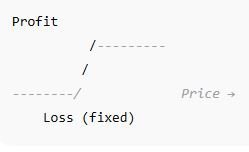
STRATEGY 2: Bear Put Spread (Debit Strategy)
Best for downward trend or breakdown
When to Use:
- Downtrend
- Breakdown of key support
- Volume expansion
- OI shift on calls
- IV low/medium
Structure:
- Buy ATM PE
- Sell OTM PE
Example:
- Buy 20,000 PE @ ₹110
- Sell 19,900 PE @ ₹60
Net debit = ₹50
Max profit = ₹50
Same logic as bull call spread but for downside.
STRATEGY 3: Credit Spread (Safe Selling Strategy)
Best for sideways or slow trend days
This is the safest way to sell options.
When to Use:
- High IV
- Sideways market
- Trending but slow movement
- Clear support/resistance
- During mid-week or expiry week
Structure:
CE Side Example:
- Sell 20,200 CE @ ₹80
- Buy 20,300 CE @ ₹40
Net credit = ₹40
Max loss = ₹60
Why Sellers Love It:
- Risk-defined
- Theta decay profits
- Great ROE
- Very beginner-friendly
- Works even when direction is slightly wrong
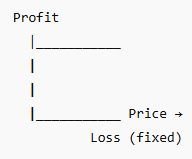
STRATEGY 4: Iron Condor (The Range-Bound Income Machine)
Professional favorite for weeks with no big events
When to Use:
- IV High
- Market in range
- Strong support + resistance
- PCR near 1
- Option chain balanced
- No major news
Structure:
- Sell OTM CE
- Buy far OTM CE
- Sell OTM PE
- Buy far OTM PE
You earn premium from both sides.
Why Condor Works:
- Extremely safe
- Very high probability
- Limited risk
- Works in 70–80% market conditions

STRATEGY 5: Iron Fly (Expiry Traders’ Weapon)
Used for premium decay + gamma slowdown
When to Use:
- Expiry day
- Price magnet to ATM
- OI heavy at ATM strike
- Low trend movement
- Neutral bias
Structure:
- Sell ATM CE + ATM PE
- Hedge with far OTM CE + PE
Why It Removes Risk:
- Net credit huge
- Risk small
- Perfect for slow expiry
- High payout if price stays near ATM
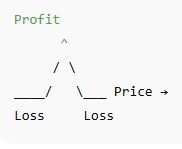
STRATEGY 6: Calendar Spread (For Volatility Traders)
Trade IV difference across expiries
When to Use:
- When current week IV is high
- Next week/month IV is low
- Before major events
- Before elections, results
Structure:
- Sell near-term option
- Buy far-term option
You benefit from:
- IV mean reversion
- Theta imbalance
This is an institutional volatility strategy.
STRATEGY 7: ATM Straddle (For Big Moves Only)
High-risk, high-reward
When to Use:
- Huge breakout expected
- News
- Explosion in price
- Strong candle
- Trend day conditions
Structure:
- Buy ATM CE
- Buy ATM PE
If market moves big in ANY direction → massive profit.
BUT:
- Theta is high
- IV crush possible
Used ONLY by advanced traders.
STRATEGY 8: ATM Strangle (Directionless Play with Volatility)
Cheaper than straddle.
Structure:
- Buy slightly OTM CE
- Buy slightly OTM PE
Use when expecting:
- volatility expansion
- big move but unsure direction
STRATEGY 9: Bull Put Spread (Credit Strategy)
Best if expecting moderate bullishness
Sell OTM PE
Buy further OTM PE
Earns premium if market stays above put strike.
STRATEGY 10: Bear Call Spread
Best for moderate bearishness
Sell OTM CE
Buy further OTM CE
Earns premium if market stays below call strike.
The 5 Trend-Following Combo Systems (Pro-Level)
These are complete systems — not just strategies.
System 1: Trend + OI Confirmation Entry
Rules:
- Higher highs/higher lows → Buy CE
- Lower highs/lower lows → Buy PE
- OI increasing ON YOUR SIDE
Example:
- Trend up
- Put OI increasing
- Volume breaking
- Buy 0.50 Delta CE
System 2: Delta Force System (Buy ITM when momentum strong)
When trend extremely strong:
- Buy ITM Delta 0.60–0.70
- Faster premium
- Higher win rate
System 3: Breakout + Gamma Expansion Combo
On breakout:
- Buy ATM
- Gamma expands
- Delta increases
- Premium explodes
Amazing intraday system.
System 4: IV Crush Trap (For Sellers)
Before event:
- IV high
- Sell hedged positions
After event:
- IV crashes
- Profit instantly
System 5: Range Reversal Condor
Use OI + structure to form condors at boundaries:
- Sell CE above resistance
- Sell PE below support
Earn from time decay.
Strategy Selection Master Table (Institutional Cheat Sheet)
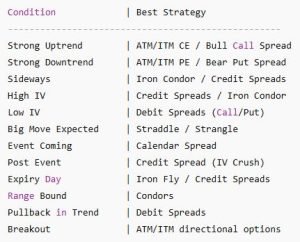
This table alone makes strategy selection EASY.
Chapter Summary
You now understand:
- debit spreads
- credit spreads
- iron condors
- iron flies
- calendar spreads
- straddles
- strangles
- professional combo systems
- volatility strategies
- trend systems
- when to use which strategy
- how to think structurally
This is the ultimate strategy chapter.
You now trade on the same mental framework as professional traders.
⭐ CHAPTER 14 – BUILDING YOUR PERSONAL TRADING SYSTEM
The Complete Blueprint — Setup, Rules, Entries, Exits, Strategy Selection, Journaling & Optimization
Before We Begin — The Definition of a Trading System
A trading system is:
A repeatable set of rules that tell you EXACTLY when to enter, exit, manage, and select trades — with ZERO emotion.
A real trading system answers:
- When do I trade?
- When do I NOT trade?
- Which setups do I take?
- Which setups do I avoid?
- What risk do I use?
- When do I enter?
- How do I exit?
- How do I size positions?
- What do I do after losses?
- What do I do after wins?
This chapter builds a system so strong that:
**Your emotions become irrelevant
because your SYSTEM runs the show.**
The 7 Components of a Perfect Trading System
Every professional trading system contains:
- Market Selection
- Timeframe Selection
- Setup Identification
- Entry Rules
- Exit Rules
- Risk Management Rules
- Review & Optimization Loop
We will build each one — step-by-step.
COMPONENT 1: Market Selection
Select ONE primary market you specialize in
A specialist earns more than a generalist.
Pick ONE:
Your system becomes tighter.
Professionals know their market’s:
- behavior
- volatility
- traps
- fakeouts
- OI dynamics
- time-of-day rhythm
COMPONENT 2: Timeframe Selection
Your primary timeframe depends on your personality.
✔ For fast traders:
5-min chart
1-min for scalps (optional)
✔ For precision traders:
5-min + 15-min combo
✔ For buyers:
5-min for structure
1-min only for entry refinement
✔ For sellers:
15-min for structure
5-min for entry
Pick ONE structure timeframe and stick to it.
COMPONENT 3: Setup Identification
You only need 2–3 high-quality setups.
Professionals don’t trade 10 setups.
They trade 2 or 3 masterfully.
Here are the BEST ones for your system:
SETUP 1: Breakout + Retest (High Probability)
Steps:
- Price consolidates
- Breakout candle forms
- Retest to breakout zone
- Entry on rejection candle

Best for buyers.
SETUP 2: Trend Continuation (The Engine Setup)
Steps:
- Trend clearly up or down
- Pullback forms
- Enter on higher low (uptrend)
- Enter on lower high (downtrend)
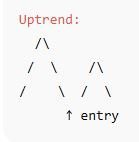
SETUP 3: Range Sell (For Sellers)
Steps:
- Identify strong support/resistance via OI
- Sell CE above resistance
- Sell PE below support
- Use spreads for safety
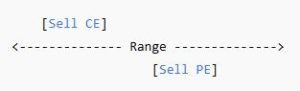
Simple and powerful.
SETUP 4: Gamma Expansion Breakout (Momentum Setup)
Only for high momentum conditions.
Use:
- ATM options
- Strong candles
- Strong volume
premium explodes.
Pick 2 setups for buying
and 1 setup for selling.
COMPONENT 4: Entry Rules (Your System’s “Green Light”)
Here are the mandatory entry filters:
✔ ENTRY FILTER 1: Trend Confirmation
Higher highs = CE only
Lower lows = PE only
✔ ENTRY FILTER 2: OI Confirmation
For CE: Put OI rising, Call OI reducing
For PE: Call OI rising, Put OI reducing
✔ ENTRY FILTER 3: IV Condition
Low/medium IV → Buying
High IV → Selling
✔ ENTRY FILTER 4: Volume Confirmation
Candle must have:
- above-average volume
- clear body
- not a random spike
✔ ENTRY FILTER 5: Structure Confirmation
Entry candle must:
- break structure
- retest
- OR form continuation pattern
✔ ENTRY FILTER 6: No News Within 20 Minutes
Avoid high volatility windows.
✔ ENTRY FILTER 7: Time-of-Day Filter
Every trader must choose a trading window:
Best windows:
- 9:20–11:15 AM (high volatility + clean trends)
- 2:15–3:15 PM (closing moves)
Avoid:
- 12–1:30 PM (flat, sideways, theta-kill zone)
COMPONENT 5: Exit Rules (Where Real Money Is Made)
A great exit system can fix:
- bad entries
- emotional mistakes
- volatility traps
- reversal situations
Here are pro exit rules:
EXIT RULE 1: Fix Profit Targets
- Partial exit at +30%
- Full exit at +60–80%
Why?
Because gamma reversals kill profits fast.
EXIT RULE 2: Exit on Opposite Candle
If a candle closes strongly against your direction → EXIT.
EXIT RULE 3: SL Hit → Stop Trading for 10 Minutes
Avoid revenge trades.
EXIT RULE 4: Time-Based Exit
If trade doesn’t move in 10–15 minutes, EXIT.
Sideways kills buyers.
EXIT RULE 5: Exit Before Big Events
No gambling.
EXIT RULE 6: Close Early if IV collapses
Especially important for option buyers.
COMPONENT 6: Risk Management Rules
(You already learned these — now we convert them into fixed system rules.)
Here are your system rules:
Risk per trade: 1–2% of capital
Stoploss: 25–35% of premium (for buyers)
Position size: 1–2 lots max (for buying)
Max trades/day: 2–3
Max losses/day: 2
Max loss/day: 3–5%
No revenge trades
No adding to losing trades
No naked selling
Only hedged selling
These are non-negotiable.
COMPONENT 7: The Review & Optimization Loop
The part 98% of traders skip.
A trading system is not complete without:
✔ Journaling
✔ Review
✔ Optimization
The Perfect Trade Journal Template (Institutional Format)
Every trade must record:
- Date
2. Strike
3. Direction (CE/PE)
4. Setup used
5. Entry reason
6. Entry signal candle
7. OI reading
8. IV reading
9. Stoploss
10. Risk
11. Exit reason
12. Emotion level (1–10)
13. Mistake identified
14. What to improve
15. Screenshot of chart
After 50–100 trades, your system becomes IRONCLAD.
The Weekly Review Ritual
Every weekend, review:
Winning trades → what went right?
Losing trades → what went wrong?
Was emotion involved?
Was risk management followed?
Did entries follow rules?
Did exits follow rules?
Which setup performed best?
Which setup underperformed?
What will you change next week?
This upgrades your system weekly.
The “Rule-Book PDF” (Your Trading Constitution)
Every professional has a written rulebook.
Your rulebook should include:
- allowed setups
- allowed timings
- entry rules
- exit rules
- SL rules
- risk rules
- psychology rules
- stop-trading conditions
This is your constitution.
Follow it blindly.
The S.T.A.R. System for Personalization
(Your Custom Blueprint Framework)
S.T.A.R. stands for:
S = Setup Selection
T = Timing Windows
A = Adjustments & Risk Rules
R = Review Loop
If these 4 components are strong, you are unstoppable.
Your Complete Personal Options Trading System (Final Blueprint)
Below is a ready-to-use system template:
🎯 MARKET
NIFTY (primary)
📊 TIMEFRAME
5-min structure
1-min entry (optional)
🧩 SETUPS
- Breakout with retest
- Trend continuation
- Credit spread range sell
🚦 ENTRY RULES
- Trend confirmed
- OI aligned
- IV conditions satisfied
- Volume above average
- Entry candle is breakout/retest/continuation
- No news for 20 minutes
- Only trade between 9:20–11:15 & 2:15–3:15
📉 EXIT RULES
- Partial at +30%
- Full at +60–80%
- Time stop: 15 minutes
- Exit on opposite candle
- SL = 25–35% of premium
- Never hold after structure break
🔐 RISK RULES
- 1–2% per trade
- 2–3 trades/day max
- Stop after 2 SL hits
- Never increase risk after loss
- No naked selling
📘 REVIEW
Daily: Post-market notes
Weekly: Performance review
Monthly: System update
This is your professional-grade, personalized trading system.
Chapter Summary
You now built:
- your setups
- your timing
- your entry logic
- your exit logic
- your risk rules
- your review framework
- your weekly optimization
- your personal rulebook
- your system identity
This chapter transforms you from:
“Someone who trades.”
to:
“Someone who follows a system.”
This is where consistency is born.
⭐ CHAPTER 15 – REAL-WORLD TRADING EXAMPLES, CASE STUDIES & FULL TRADE WALKTHROUGHS
A Complete Practical Breakdown of Trades From Start to Finish
Why This Chapter Matters
You now know:
- Greeks
- IV
- OI
- options buying
- options selling
- spreads
- psychology
- risk rules
- entry & exit systems
- strategy selection
- your personal blueprint
Now you MUST see how all of this applies in real trading conditions.
This chapter gives you:
✔ full case studies
✔ complete trade walkthroughs
✔ what worked, what failed, why
✔ how entries form
✔ how exits are decided
✔ how OI confirms movement
✔ how IV affects premium
✔ how mistakes destroy trades
Let’s begin with the most common & powerful scenario:
⭐ CASE STUDY 1 — Trend Continuation CE Trade
NIFTY Buying Call on Uptrend Pullback (Textbook Example)
Market Conditions
- NIFTY = 20,020
- Strong uptrend
- Higher highs + higher lows
- OI shows PUT buildup rising
- Volume rising on up candles
- IV stable
- No major news
chart (simplified):
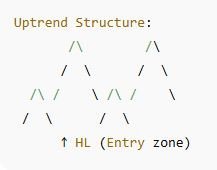
Your Preparation
System says:
- Trend → CE only
- Low/medium IV → buying allowed
- Time-of-day: 10:05 AM (good)
- Setup → Trend continuation
- Strike → ATM CE (20,000 CE)
The Signal Candle
A bullish hammer forms at a higher low.
Volume above average.
OI:
- Put OI ↑ at 20,000
- Call OI ↓ at 20,000
This is institutional confirmation.
The Trade
Buy 20,000 CE @ ₹118
Stoploss = 25% → ₹88
Risk = ₹30 per lot
The Move
NIFTY moves from 20,020 → 20,095 in 18 minutes.
Premium jumps from ₹118 → ₹178.
Exit
System rule:
- Partial exit at +30%
- Full exit at +60–80%
You book:
- Partial at ₹155
- Full at ₹182
Net gain ≈ 55–60%
Pure structure + trend + OI + volume.
Learning
This is your bread-and-butter trade.
- High probability
- Low stress
- Trend following
- OI confirms
- Clean entry
- Clean exit
This setup alone, repeated consistently, is profitable.
⭐ CASE STUDY 2 — Breakout + Retest CE Trade
Classic Professional Entry Scenario
Market Conditions
- NIFTY at 19,950
- Strong resistance at 19,980
- Consolidation tight
- IV low
- Volume drying
- Put OI building at 19,900
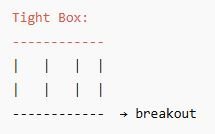
Breakout Candle
A long green candle breaks 19,980 with high volume.
But professional traders do NOT enter here.
This is where beginners FOMO and lose.
Professionals WAIT for retest.
Retest Candle
Price comes back to 19,980.
Forms a small bullish pin bar.
Volume stable.
Put OI increasing.
Entry
Buy 19,900 CE @ ₹140
SL = 35% → ₹90
Move
Price jumps to 20,040.
Premium goes from ₹140 → ₹205.
Exit
Full exit at +60%.
Learning
The edge here is in the retest, not the breakout.
Professionals wait.
Beginners chase.
⭐ CASE STUDY 3 — Breakdown PE Trade
The most profitable type of PE trade
Market Conditions
- NIFTY testing support at 19,880
- Lower highs forming
- Weak momentum
- Call OI rising
- IV stable
- Global cues weak
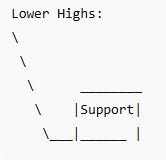
Entry
Buy 19,900 PE @ ₹115
SL = ₹85
Move
Price falls to 19,820.
Premium jumps to ₹200.
Exit
Full exit at +70%.
Learning
Breakdowns with OI confirmation = extremely strong trades.
⭐ CASE STUDY 4 — Trend Trap (Failed Trade Example)
A realistic loss scenario — and why the loss happened.
Market Conditions
- NIFTY in uptrend
- You see a pullback
- You buy 20,000 CE
Entry: ₹150
SL: ₹110
The Trap
Price fakes a reversal →
but OI does NOT confirm.
Put OI was falling, not rising.
Call OI was not reducing.
This is the sign big players are NOT supporting your entry.
Outcome
Price collapses back into range.
Premium goes from ₹150 → ₹115 → ₹110 → SL hit.
Learning
This loss was caused by:
- ignoring OI
- entering too early
- weak volume
- no confirmation
Loss is normal.
But it should be small and controlled.
⭐ CASE STUDY 5 — Iron Condor Income Setup
Weekly income example
Market Conditions
- NIFTY range: 19,850–20,100
- IV high
- No events
- OI heavy at 20,100 (CE)
- OI heavy at 19,800 (PE)
Perfect condor.
Structure
- Sell 20,100 CE
- Buy 20,200 CE
- Sell 19,900 PE
- Buy 19,800 PE
Net credit = ₹38
Max loss = ₹62
Move
NIFTY stays in range all week.
Both premiums decay.
You keep full ₹38 credit.
Learning
Condors shine in RANGE markets.
This is a professional income strategy.
⭐ CASE STUDY 6 — IV Crush Example
Why buyers lose before events
Before RBI Policy
- IV = 24%
- 20,000 CE = ₹135
- Many beginners buy expecting big move
After Policy
- IV drops sharply to 14%
- NIFTY moves up 40 points
- But premium DROPS to ₹107
Trader loses ₹28 even though direction was right.
Learning
Never buy before events.
IV crush destroys buyers.
⭐ CASE STUDY 7 — Seller’s Panic Example
Why naked selling is dangerous
Trade
A beginner sells 20,200 CE naked.
No hedge.
Move
NIFTY instantly breaks out due to global rally:
- Premium jumps from ₹45 → ₹190
- Loss: HUGE
- No stoploss
- No hedge
Learning
Never sell naked.
Ever.
⭐ CASE STUDY 8 — Credit Spread Safe Adjustment Example
How pros manage a threatened position
Initial Trade
Sell 20,200 CE
Buy 20,300 CE
Net credit = ₹40
Market Moves Up
NIFTY jumps from 20,000 → 20,180
Your CE strike is under threat.
Adjustment
Close old spread.
Roll higher:
Sell 20,300 CE
Buy 20,400 CE
Market stabilizes.
New credit + old adjustment keeps profit alive.
⭐ CASE STUDY 9 — Time-Based Exit Example
Why buyers MUST exit when movement stops
Trade
Buy 20,000 CE @ ₹110
Trend strong
Setup clean
Issue
Market goes sideways for 12 minutes.
Premium falls to ₹105 → ₹100 → ₹94.
Exit
Time-based exit rule triggers.
Exit at ₹100.
Learning
When movement stops → option dies.
Time stoploss is essential.
⭐ CASE STUDY 10 — Gamma Explosion on Expiry (Scalper Example) Market
Expiry day.
NIFTY = 19,995.
ATM CE = ₹32
ATM PE = ₹28
Gamma extremely high.
Move
NIFTY jumps to 20,020:
- CE shoots to ₹48
- PE collapses to ₹12
Scalpers make quick profit.
Reversal puts them in danger again.
Learning
Expiry = fast money, fast loss.
Only for trained scalpers.
⭐ Key Takeaways Across All Case Studies
From these 10 case studies, the lessons become crystal clear:
Trend + Structure + OI = Best trades
Breakout + Retest = Strong confirmation
OTM buying = slow death
IV crush = buyer killer
Credit spreads = safe selling
Condors = best weekly income
Never sell naked
Time stoploss is essential
Buy only when the market MUST move
Sell when the market is NOT moving
Avoid news events
Use only ATM/ITM for buying
This chapter gives you real-life mastery, not just theory.
⭐ CHAPTER 16 – TOOLS, PLATFORMS, RESOURCES & WHY DHAN IS THE BEST BROKER FOR OPTIONS TRADERS
The Complete Professional Toolkit
Before We Begin — Why Tools Matter More Than You Think
Trading is NOT just:
- charts
- strategies
- Greeks
- entries
- exits
Professional traders use tools to:
- read option chain properly
- check OI instantly
- check IV quickly
- build strategies visually
- monitor Greeks
- track portfolios
- automate risk management
- use multi-leg strategy builders
- scan for setups
- avoid emotional mistakes
Without the right tools,
trading becomes emotional → messy → inconsistent.
This chapter gives you:
- Every platform you should use
- Every tool you need
- Every charting resource
- Every scanner required
- And WHY Dhan is the #1 choice for options
Let’s begin.
The Professional Options Trading Stack (The Ultimate Toolkit)
Here’s the full “institutional-level” toolkit every serious options trader needs:
1) Charting Platform
✔ TradingView (preferred)
For:
- structure
- trend
- price action
- indicators
- alerts
- session analysis
2) Options Platform / Broker (Critical)
✔ DHAN (Best for options — explained in section given below)
3) Analytics & Scanners
✔ Opstra
✔ Sensibull
✔ Quantsapp
Used for:
- advanced OI
- IV charts
- backtesting
- multi-leg strategy builder
- Greek analysis
- PCR movement
- Max Pain
- volatility skews
4) Algo / Auto Monitoring (optional)
- Tradetron
- AlgoTest
- Quantower (advanced)
5) Journaling Platform (Important)
- Notion
- Excel sheet
- Google Sheets
- TraderSync
- TradeBench
Professionals journal EVERY trade.
6) News & Macro Tools
- Moneycontrol
- Investing.com
- NSE website
- RBI website
- Economic calendar
Knowing event risk = essential.
7) Position Sizing & Risk Calculators
- Dhan’s inbuilt calculators
- Opstra position sizing tool
These prevent over-risking.
The MUST-HAVE Features Every Options Trader Needs in a Broker
For success in options trading, your broker MUST provide:
1️⃣ Fast Order Execution
Because:
- premiums move fast
- expiry days are chaotic
- scalpers need speed
- slippage must be minimal
2️⃣ Options Strategy Builder
No manual calculation for:
- Greeks
- sellers’ risk
- hedges
- margin
- payoff
3️⃣ Live OI & Option Chain Integration
Without real-time OI,
you are trading blind.
4️⃣ Margin Benefits on Hedges
If your broker doesn’t reduce margin for hedged trades…
you are wasting capital.
5️⃣ Reliable App + Web + TradingView Integration
Traders need:
- charts on one screen
- order panel on other screen
6️⃣ Fast API (for advanced traders)
For:
- automation
- custom tools
- strategy building
7️⃣ Clean UI + Low Latency
You must be able to trade:
- spreads
- condors
- multi-leg strategies
with ZERO lag.
Why Most Beginners FAIL Because of Their Broker
Let’s be brutally honest:
Most beginners lose because their brokers:
- lag
- freeze
- don’t have OI tools
- don’t have IV charts
- don’t show Greek values
- make multi-leg trading difficult
- charge high margins
- have poor execution
- slip frequently
A weak broker kills:
- discipline
- risk management
- execution
- psychology
Having the right broker is 50% of success.
The 10 Broker Problems Dhan Solves
Most brokers have problems like:
❌ Slow execution
❌ No OI charts
❌ No IV charts
❌ No payoff diagrams
❌ High margin for selling
❌ Poor multi-leg builder
❌ Slippage issues
❌ No API
❌ Poor web platform
❌ No dedicated options tools
Dhan solves ALL of these.
Why DHAN Is the Best Broker for Options Traders (Deep Explanation)
Not hype — actual features that matter to professionals
Dhan has built the strongest options infrastructure in India.
Let’s break it down.
⭐ Reason 1 — Best Option Chain in India
Dhan’s option chain gives:
- live OI
- OI change (crucial!)
- real-time Greeks
- IV
- PCR
- volume
- bid-ask spread
- ATP
Everything on ONE screen.
No need for external tools to read realtime chain.
⭐ Reason 2 — Strategy Builder (Multi-Leg Execution)
This is game-changing
You can:
- build credit spreads
- build debit spreads
- build condors
- build iron flies
- build straddles
- build strangles
ALL with:
- margin preview
- payoff diagram
- max profit
- max loss
- Greeks
- IV impact
Executed in ONE click.
Professionals rely on this daily.
⭐ Reason 3 — TradingView Integration (Best in India)
Dhan allows:
- TradingView charts
- Dhan order panel
- Multi-device sync
- Fast execution from TV
This is crucial for:
- scalpers
- momentum buyers
- expiry traders
No other broker’s TV integration is as smooth.
⭐ Reason 4 — Lighting-Fast Execution Engine
Dhan’s backend infrastructure is built for:
- low latency
- fast fills
- reliable queues
- stable volatility handling
During:
- budget
- elections
- expiry
- big moves
Dhan remains stable.
This is critical for option buyers & sellers.
⭐ Reason 5 — Margin Benefit for Hedges
Hedged selling gets MUCH lower margin.
For example:
- Naked CE sell might need ₹1.2 lakh
- Hedged CE/CE spread on Dhan may need ₹18,000–₹30,000
Huge difference.
This allows:
- safer selling
- defined risk trades
- diversified strategies
⭐ Reason 6 — Options Dashboard (Pro-Grade)
You get:
- OI heatmaps
- IV charts
- PCR insights
- Max Pain
- Trend tools
- F&O analytics
Perfect for intermediate & advanced traders.
⭐ Reason 7 — Zero Dark Patterns
No shady:
- delay
- manipulation
- forced slippage
- random rejections
- freezing charts
Dhan’s transparency is unmatched.
⭐ Reason 8 — Event-Proof Platform Stability
During Budget, RBI, US Fed nights:
- other brokers freeze
- Dhan stays stable
This alone prevents huge losses.
⭐ Reason 9 — API Access (for Advanced Traders)
Dhan provides:
- fast API
- Python compatibility
- bot building
- custom scanners
- auto strategies
Great for innovators & systematic traders.
⭐ Reason 10 — The Fastest Growing Options Platform
Dhan is focused on:
- options
- derivatives
- traders
- strategy builders
- performance features
Not beginners.
Not casual investors.
It is built for TRADERS.
Tools Inside Dhan That Make a Real Difference
Here are the 8 most important built-in tools:
- Strategy Builder
- Option Chain
- OI Analyzer
- IV Analyzer
- Payoff Graph
- Multi-Leg Execution
- F&O Dashboard
- Fast TradingView Integration
These tools directly improve:
- win rate
- decision making
- execution quality
- risk management
- confidence
⭐ What Beginners Should Use Inside Dhan
✔ Option Chain
✔ IV Chart
✔ Basic Spreads
✔ Payoff
✔ TradingView + Order Panel
What Intermediate Traders Should Use
✔ Iron Condors
✔ Multi-leg execution
✔ IV analysis
✔ OI heatmaps
✔ Strategy testing
What Advanced Traders Should Use
✔ API
✔ Volatility models
✔ Hedged strangles
✔ Calendar spreads
✔ Custom bots
Dhan Brokerage & Charges
₹0 on equity delivery
₹20 or 0.03% (whichever lower) per executed order for intraday, F&O, commodity, and currency.
No hidden charges, no minimum balance.
Other Fees:
Service | Charges |
|---|---|
Account Opening | ₹0 |
Annual Maintenance (AMC) | ₹0 |
Pledge/Unpledge | ₹12.5 per request |
Auto-square off | ₹20 per order |
Verdict: ✅ Transparent, simple, and competitive.
Dhan Trading Platforms (Web + App + Dedicated Options App)
1. Dhan Web
Full-fledged professional interface
Real-time charts powered by TradingView
Fast execution & 20-depth market view
Multi-tab workspace for multiple scripts
2. Dhan Mobile App
Clean, intuitive UI
Live option chain data
Pre-built strategies for beginners
Advanced indicators & pattern recognition
3. Dhan Options Trader App
Specifically designed for options traders
Built-in strategy builder (free)
Live Greeks (Delta, Theta, Gamma, Vega)
IV, PCR, Max Pain analytics
“Payoff” graph for visual risk/reward analysis
Advanced Features That Make Dhan Stand Out
🧩 1. Native TradingView Integration
Direct chart trading from TradingView.
Place, modify, or cancel orders from the chart — no toggling screens.
⚡ 2. Scalper Mode
For high-frequency intraday traders.
Execute orders instantly with one tap.
💡 3. Iceberg & Super Orders
Split large trades automatically for better execution.
Set entry, SL, and target in one click.
🔍 4. ScanX Screener
Technical + fundamental screener with live trends.
Detect breakouts, momentum shifts, and candlestick patterns.
🔔 5. Trader Controls
Smart alerts to prevent over-trading or margin exhaustion.
Ideal for disciplined trading.
🤖 6. API & Algo Trading
Free API access for all users.
Compatible with Python, TradingView alerts, or third-party platforms.
Margin & Leverage (MTF)
Dhan offers up to 4× leverage (75% funding) for equity delivery under Margin Trading Facility (MTF).
You can buy delivery shares by paying only 25% upfront.
Pledge existing holdings for additional leverage.
Intraday Margin:
Equity: Up to 5x
Index Options: 1x to 2x (based on liquidity)
Futures: Full margin applicable as per SEBI norms
Charting, Technical Analysis & Tools
TradingView & ChartIQ both supported.
Multiple indicators (200+ built-in).
Multi-timeframe charts.
Advanced drawing tools.
Auto-detection of candlestick patterns.
Pro Tip:
Dhan’s native TradingView integration is unique — you can trade directly from your chart, not just analyze. Perfect for scalpers and short-term traders.
Order Types & Execution
Market, Limit, SL, SL-M orders
Cover Orders (CO), Bracket Orders (BO)
Forever Orders (GTT equivalent)
Iceberg, Super Orders, and Basket Orders
Average order execution speed: <20 milliseconds
That’s faster than almost every other Indian broker.
Dhan for Options Trading
If you trade Nifty, Bank Nifty, or FINNIFTY options — Dhan’s Options Trader App is one of the most advanced in India.
Key Highlights:
Full options chain with Greeks
Built-in Strategy Builder
IV, OI, PCR, Max Pain, and Intrinsic Value analytics
Ready-made & customizable strategies
Instant margin calculator
Payoff chart visualizer
Verdict:
Dhan is currently the #1 options trading app in India (2025) — combining speed, analytics, and zero additional charges for strategy tools.
Dhan for Intraday Trading
For active intraday traders, Dhan delivers:
Super-fast execution (20ms latency)
Scalper Mode for one-tap trading
Advanced chart-based orders
Real-time depth (20 levels)
Smart order types like Iceberg
In a 3-month real test (2025 Q2):
No major downtime
Execution accuracy >99.8%
Average slippage <0.03%
Verdict:
Perfect for scalpers, day traders, and short-term positional setups.
If you’re looking for a modern, feature-rich, and trader-friendly platform, Dhan is easily one of the best choices available today. From zero account opening charges to advanced tools like native TradingView, options strategy builder, and free API access, Dhan is clearly built with the modern Indian trader in mind.
Whether you’re an intraday trader, an options strategist, or a long-term investor, Dhan offers the perfect blend of speed, simplicity, and smart technology — without burning a hole in your pocket.
Why wait? Open your Dhan account now and take control of your trading journey with confidence.
👉 Click here to get started with Dhan
Open a Free Dhan Trading & Demat Account
Dhan offers cutting-edge tools for fast, powerful, and informed trading:
- ✅ Zero brokerage on delivery trades
- ✅ Auto-detection of candlestick patterns on charts
- ✅ Advanced Option Chain with Greeks, Max Pain, PCR & more
- ✅ Pre-built & custom Option Strategy Builder (Free)
- ✅ 20 Depth Market Data and Flash Trade execution
- ✅ Margin Trading Facility (MTF) with 4X leverage (75%)
- ✅ 3 Platforms: Mobile App, Web App & Dedicated Options App
- ✅ ScanX Screener: stock insights, trends & news
- ✅ Advanced orders: Trailing SL, Iceberg, Forever Orders
- ✅ Instantly pledge 1,500+ stocks for options margin
- ✅ Trade commodities: Gold, Silver, Crude, Natural Gas
- ✅ Fundamental + Technical analysis across all platforms
No paperwork. Zero account opening charges. Setup in minutes.
Customer Support & Reliability
24×7 email and chat support
Dedicated trading desk for active traders
Fast response via Telegram and Twitter
User Ratings:
| Platform | Rating | Reviews |
|---|---|---|
| Play Store | ⭐4.6 | 200K+ |
| App Store | ⭐4.5 | 70K+ |
| Web App | Highly rated for speed & UI |
Dhan vs Competitors (Quick Comparison)
Feature | Dhan | Upstox | Zerodha | Fyers | Groww |
|---|---|---|---|---|---|
Brokerage | ₹20/order | ₹20 | ₹20 | ₹20 | ₹20 or 0.05% |
Account Opening | Free | Free | Paid (₹200) | Free | Free |
TradingView Integration | ✅ Native | ⚙️ Partial | ❌ | ✅ Built-in | ❌ |
API Access | ✅ Free | Paid | Paid | Free | ❌ |
Options Strategy Builder | ✅ Advanced | Limited | ❌ | ✅ Basic | ❌ |
Speed | ⚡ Ultra-fast | Fast | Moderate | Fast | Average |
Margin (MTF) | ✅ 4× | ✅ 4× | ❌ | ✅ 4× | ❌ |
Verdict:
Dhan beats most brokers on speed, tech, and trader tools — especially for intraday and options trading.
How to Open a Dhan Account?
Visit https://dhan.co
Click “Open Free Account”
Upload PAN, Aadhaar & bank details
Complete eSign using Aadhaar OTP
Start trading instantly (no paperwork)
💥: Open Free Dhan Account Now – 100% online in under 5 minutes.
Chapter Summary
You now understand:
- which tools matter
- how professionals build a toolkit
- what features a broker must have
- the problems with normal brokers
- why Dhan is superior
- how each tool improves your trading
- which features suit which type of trader
This chapter makes your trading faster, safer, smarter, and more profitable —
because your tools now match your skill.
⭐ CHAPTER 17 – THE COMPLETE OPTIONS TRADING GLOSSARY
(Beginner → Intermediate → Advanced • 200+ Terms Explained Simply)
Why This Glossary Matters
Options trading uses jargon-heavy language.
Beginners feel lost because they see:
- Greeks
- IV
- OI
- Delta
- Gamma
- Vega
- Theta
- Moneyness
- Rollover
- Premium decay
- Max Pain
- Spread
- Strike
- Spot
- ATM
- CE / PE
This chapter gives you:
✔ Every important term
✔ Explained simply
✔ With short examples
✔ Zero complexity
✔ Quick-reference friendly
Your will LOVE this section because it removes 100% confusion.
Let’s begin.
⭐ SECTION A — BASIC OPTIONS TERMINOLOGY (FOUNDATION)
- Option
A financial contract that gives you the right but not obligation, to buy/sell an underlying asset at a fixed price.
- Call Option (CE)
A bullish option — profits when price goes UP.
- Put Option (PE)
A bearish option — profits when price goes DOWN.
- Strike Price
The pre-decided price at which you have the right to buy/sell.
Example:
20,000 CE → strike = 20,000
- Premium
The price of the option.
If NIFTY 20,000 CE = ₹110
Premium = ₹110
- Expiry
The date on which the option contract ends.
- Spot Price
The current trading price of the underlying asset.
- Lot Size
Options trade in fixed quantities (lots).
Example: 1 NIFTY lot = 50 units.
- ATM (At The Money)
Strike closest to spot price.
Spot = 20,012
ATM = 20,000 CE/PE
- ITM (In The Money)
Option with intrinsic value.
For CE: Spot > Strike
For PE: Spot < Strike
- OTM (Out of The Money)
Option with no intrinsic value.
- Intrinsic Value
Real, guaranteed value if exercised NOW.
Example:
Spot = 20,050
CE 20,000 → Intrinsic = 50
- Time Value
Extra premium because time is left to expiry.
- Theta Decay
Premium losing value as time passes.
- Volatility
How fast price moves.
Higher volatility → higher premiums.
⭐ SECTION B — GREEKS (THE PROFESSIONAL LAYER)
- Delta
How much premium changes when underlying moves ₹1.
Example:
Delta = 0.50
Underlying moves +10 → premium +5
- Gamma
How fast Delta changes.
High in ATM options, especially on expiry.
- Theta
Time decay — loss of premium per day.
- Vega
Sensitivity to IV (Implied Volatility).
High IV = high premium.
- Rho
Sensitivity to interest rates.
Rarely used in intraday trading.
- Skew
Difference in IV between strikes.
⭐ SECTION C — IMPLIED VOLATILITY (IV) TERMS
- IV (Implied Volatility)
Measures expected volatility.
High IV → expensive premiums.
Low IV → cheaper premiums.
- IV Crush
Sharp fall in IV → premiums collapse.
Common after events/news.
- IV Spike
Sudden rise in IV → premiums inflate.
- Volatility Smile
Pattern where OTM options have higher IV.
- Volatility Skew
Unequal IV for calls vs puts or different strikes.
- Historical Volatility
Actual past volatility.
Not as important as IV for options.
⭐ SECTION D — OPTION CHAIN & OI (OPEN INTEREST)
- Open Interest (OI)
Number of open option positions.
Huge OI → strong support/resistance.
- OI Buildup
Increase in OI = stronger level.
- OI Unwinding
Decrease in OI = level weakening.
- PCR (Put-Call Ratio)
Put OI ÷ Call OI → indicates sentiment.
PCR > 1 = bullish
PCR < 1 = bearish
- Max Pain
Strike where buyers lose max money.
Used by option sellers.
- OI Trend Shift
When OI moves from one strike to another — signals direction change.
- Pain Zone
Highest OI region — market avoids breaking this easily.
⭐ SECTION E — ORDER TYPES
- Market Order
Instant order at best available price.
- Limit Order
Order at your chosen price.
- Stoploss Order
Trigger-based exit to limit loss.
- SL-M (Stoploss Market)
Exit immediately once triggered.
- SL-L (Stoploss Limit)
Exit at a chosen price once triggered.
- Bracket Order
Entry + SL + target (not available for all segments).
⭐ SECTION F — OPTION BUYING TERMINOLOGY
- Premium Erosion
Slow premium decay when market doesn’t move.
- Gamma Burst
Sudden premium explosion.
- Delta Flip
When ATM goes ITM → delta jumps.
- Trap Entry
False breakout causing premium collapse.
- Momentum Burst
Large candle with volume → premium skyrockets.
- Risk-Defined Buy
Using ITM options to reduce volatility.
⭐ SECTION G — OPTION SELLING TERMINOLOGY
- Naked Selling
Selling without hedge.
High risk.
- Hedged Position
Selling with protection leg.
- Credit Spread
Sell OTM, buy further OTM.
Risk defined.
- Debit Spread
Buy ATM, sell OTM.
Reduces cost.
- Iron Condor
Combine CE + PE spreads.
- Iron Fly (Iron Butterfly)
Sell ATM CE + ATM PE + hedges.
- Straddle
Buy/sell ATM CE + PE.
- Strangle
Buy/sell OTM CE + PE.
- Rollover
Close old strike, open new strike.
- Short Covering
Sellers exiting positions → causes fast upward move.
- Long Liquidation
Buyers exiting → fast downward move.
⭐ SECTION H — PRICE ACTION TERMS
- Breakout
Price moving above resistance.
- Breakdown
Price falling below support.
- Retest
Price coming back to test breakout level.
- Pullback
Small movement against the trend.
- Reversal
Trend direction changes.
- Fakeout / Trap
Breakout/breakdown that reverses quickly.
- Structure Break
Trend structure invalidated.
- Supply Zone
Area where sellers dominate.
- Demand Zone
Area where buyers dominate.
⭐ SECTION I — STRATEGY TERMS
- Payoff Diagram
Graph showing profit/loss of a strategy.
- Max Profit
Highest possible gain.
- Max Loss
Highest possible loss.
- Breakeven Points
Price levels where strategy breaks even.
- Breakeven Expansion
When OTM legs expand → breakeven shifts.
- Wing Width
Distance between strikes in spreads.
- Neutral Strategy
Profits when market stays in range.
- Directional Strategy
Profits when price moves strongly.
- Volatility Strategy
Profits from IV movement.
- Income Strategy
Steady premium-collecting strategies (selling).
- Risk-Defined Strategy
Max loss is capped.
⭐ SECTION J — RISK MANAGEMENT TERMS
- Position Sizing
How big your trade is.
- RRR (Risk Reward Ratio)
Expected risk vs expected profit.
- Capital at Risk
Amount vulnerable in a trade.
- SL Hit
Stoploss triggered.
- Drawdown
Capital falling from peak.
- Max Drawdown
Largest fall in capital during strategy lifetime.
- Daily Loss Limit
Fixed amount after which trader stops trading.
- Intraday Margin
Funds required during intraday selling.
- Portfolio Margin (Advanced)
Margin based on combined risk across positions.
⭐ SECTION K — PSYCHOLOGY TERMS
- FOMO
Fear of missing out.
- Revenge Trading
Trading aggressively after a loss.
- Overconfidence Bias
Belief you are “invincible” after wins.
- Loss Aversion
Fear of accepting losses → holding losers too long.
- Anchoring Bias
Clinging to original analysis despite new evidence.
- Confirmation Bias
Seeking information that supports your belief.
- Emotional Trading
Trading based on fear/greed instead of rules.
- Discipline
Following rules regardless of emotion.
- System Thinking
Trading based on rules & process.
- Trader Identity
Belief that “I am a rule-based trader.”
⭐ SECTION L — PRO-LEVEL TERMS (ADVANCED)
- Gamma Scalping
Adjusting delta during straddle/strangle trades.
- Vanna
Greek that measures how Delta changes with IV.
- Charm
How Delta changes as time passes.
- Skew Arbitrage
Trading differences in IV skew across strikes.
- Calendar Arbitrage
Trading IV difference between monthly/weekly expiries.
- Vega Exposure
Amount portfolio is affected by IV.
- Slippage
Difference between expected and executed price.
- Liquidity Risk
Risk of large bid-ask spreads.
- Decay Curve
Theta decay pattern over days.
- Gamma Trap
Expiry movement triggering stop losses.
- Pinning
Price magnet effect around ATM or Max Pain strike.
- Synthetic Positions
Replicating futures using options.
- Forward Volatility
Future expected IV.
- Tail Risk
Low-probability but extremely high-impact moves.
⭐ Chapter Summary
You now have a complete glossary covering:
- basic terms
- Greeks
- IV
- OI
- strategies
- psychology
- risk
- pro-level concepts
This chapter acts as a final reference dictionary for you.
⭐ CHAPTER 18 – THE 80+ MOST IMPORTANT OPTIONS TRADING FAQS — ANSWERED SIMPLY
The Ultimate Beginner-to-Pro Question Bank
(practical • simple • ultra-clarity)
This chapter is where you finally get:
- clear
- practical
- simple
- direct
- no-nonsense answers
- in plain English
- without jargon
Let’s begin.
Why This FAQ Section Is Critical
Options trading is confusing for beginners because they have simple questions but get complicated answers.
This FAQ answers every important question, from:
- basic
- medium
- advanced
- psychological
- risk
- strategy
- broker-related
- mistakes
- technical
Everything in ONE place.
⭐ SECTION A — BEGINNER QUESTIONS (THE BASICS)
1) What is a Call Option?
A contract that profits when the underlying price goes UP.
2) What is a Put Option?
A contract that profits when the underlying price goes DOWN.
3) What is Premium?
The price you pay to buy an option.
4) What is Strike Price?
The pre-decided price of the option.
5) What is Expiry?
The date when the contract ends.
6) What is Lot Size?
Options trade in fixed quantity (e.g., NIFTY = 50 units).
7) What is ATM?
Strike closest to current price.
8) What is OTM?
Strike far from current price — cheaper but lower probability.
9) What is ITM?
Strike with intrinsic value — higher probability, higher price.
10) Why do option premiums move?
Because of:
- price movement
- volatility
- time decay
- demand-supply
⭐ SECTION B — MONEYNESS QUESTIONS
11) Which strike should beginners buy?
ATM or slight ITM (0.50–0.60 Delta).
12) Should beginners buy OTM options?
NO — they decay fast and rarely succeed.
13) Why are ITM options expensive?
Because they already contain intrinsic value.
14) Why do OTM options look cheap?
Because they have low probability of success.
⭐ SECTION C — GREEKS QUESTIONS
15) What is Delta in one line?
How much premium changes with ₹1 move.
16) Which Greek matters most for buyers?
Delta & Gamma.
17) Which Greek matters most for sellers?
Theta (decay) & Vega (IV).
18) What is Theta in simple terms?
“Rent” you pay daily for holding the option.
19) Why does premium fall even if price rises?
Because:
- IV falls
- Theta decay
- Delta too low
⭐ SECTION D — IV QUESTIONS
20) What is IV?
Market’s expectation of future volatility.
21) When should I buy options?
When IV is LOW or NORMAL.
22) When should I sell options?
When IV is HIGH.
23) What is IV Crush?
When IV suddenly drops after event & premium collapses.
24) Why does premium drop after news?
IV falls → premium falls.
⭐ SECTION E — OI & OPTION CHAIN QUESTIONS
25) What is OI in simple words?
Number of open option positions.
26) High OI on PE side means?
Strong support.
27) High OI on CE side means?
Strong resistance.
28) Rising OI + Rising Price (CE)?
Bullish confirmation.
29) Falling OI + Rising Price?
Short covering rally.
30) Falling OI + Falling Price?
Long liquidation.
31) OI shifting strikes means?
Market trend is changing.
⭐ SECTION F — OPTION BUYING QUESTIONS
32) Why does option buying feel difficult?
Because you need direction + speed + low IV + timing.
33) Best time for option buying?
Morning trends (9:20–11:15 AM).
34) How fast does Theta decay impact buyers?
Very fast, especially after 12 PM.
35) Why does premium fall after I buy?
Either:
- wrong strike
- sideways market
- IV drop
- slow momentum
36) Should beginners scalp?
No — it requires advanced skill, low latency, strong psychology.
37) Should beginners trade expiry?
No — very risky due to gamma spikes.
38) Should beginners average a loss?
NEVER.
39) How many trades should a beginner take daily?
1–3 trades max.
40) Why do beginners hit SL often?
Mostly because of:
- entering too early
- entering in chop
- buying OTM
- no confirmation
⭐ SECTION G — OPTION SELLING QUESTIONS
41) Is selling safer than buying?
Yes, IF hedged.
42) Should beginners sell options?
Yes — only credit spreads (risk defined).
43) Why do option sellers win more often?
Because time decay is on their side.
44) Is naked selling safe?
Absolutely NOT.
Unlimited risk.
45) Why do sellers fear big moves?
Because they sell premium expecting the market to stay quiet.
46) Best time for selling?
Mid-day & afternoon (when market is calm).
47) Which selling strategy is safest?
Hedged spreads (Bull Put Spread, Bear Call Spread).
48) What IV is good for selling?
High IV → high premium → better selling.
⭐ SECTION H — EXPIRY QUESTIONS
49) Why is expiry so volatile?
Because gamma is very high.
50) Should beginners trade expiry?
No.
51) Why do premiums collapse after 1 PM on expiry?
Time decay accelerates massively.
52) Which strategies work best on expiry?
- Iron Fly
- Credit Spreads
- Scalping (advanced only)
53) Why does ATM premium move violently on expiry?
Gamma explosion.
⭐ SECTION I — STRATEGY QUESTIONS
54) Best strategy for beginners?
Debit spreads (Bull Call, Bear Put).
55) Best strategy for sideways markets?
Iron Condor.
56) Best strategy for strong trending markets?
ATM/ITM options.
57) Best strategy for high IV?
Credit spreads.
58) Best strategy for low IV?
Debit spreads.
59) Best strategy before big event?
Calendar spreads.
60) Best strategy for uncertain direction but big move expected?
Straddle / Strangle (only experienced traders).
⭐ SECTION J — RISK MANAGEMENT QUESTIONS
61) How much capital should I risk per trade?
1–2% max.
62) What is the safest SL for buyers?
25–35% of premium.
63) Should I increase position size after loss?
No — NEVER.
64) How many losses per day allowed?
Max 2.
65) Should I stop after hitting my daily loss limit?
Yes — immediately.
66) Should I hold losing trades?
Never.
Exit quickly.
67) Should I hold winners longer?
Yes — trail smartly.
68) What is the biggest risk mistake?
TRADING BIG SIZE.
⭐ SECTION K — PSYCHOLOGY QUESTIONS
69) Why do I panic when premium drops?
Because position size is too big.
70) Why do I book profits early?
Fear of losing small gains.
71) Why do I chase trades?
FOMO — emotional reaction.
72) Why do I enter late?
Lack of clarity or fear of missing out.
73) Why do I break my rules?
Because emotional brain overrides logical brain.
74) How do I stop overtrading?
Set max trades/day = 3.
75) How can I build confidence?
Follow your system consistently for 30–50 trades.
76) How do I stay disciplined?
Write rules. Follow rules. Review daily.
77) Biggest psychological mistake?
Revenge trading.
⭐ SECTION L — BROKER & PLATFORM QUESTIONS
78) Which broker is best for options?
Dhan — fastest execution + OI tools + TV integration + strategy builder.
79) Why not use discount brokers with basic UIs?
Because they:
- lag
- freeze
- give poor OI
- poor spreads
- no strategy builder
- slippage issues
80) Why do most professional traders prefer Dhan?
Because it offers:
- best option chain
- multi-leg strategies
- fast execution
- low-latency TV integration
- OI & IV tools
- stable infra during volatility
81) Which tools are absolutely necessary?
- TradingView
- Dhan
- Opstra / Quantsapp
- Journaling tool
82) What should beginners avoid in brokers?
- slow platforms
- no OI
- high slippage
- laggy charts
- bad mobile apps
⭐ SECTION M — MISCELLANEOUS ADVANCED QUESTIONS
83) Why do markets move toward Max Pain?
Because sellers are large players and often adjust positions.
84) Why do premiums jump suddenly?
Gamma expansion + volume spike.
85) Why do premiums collapse suddenly?
IV drop + theta + no movement.
86) Why does ATM premium move fastest?
Highest Gamma.
87) Why do ITM options have lower Theta decay?
More intrinsic value, less time value.
88) Why do OTM options decay fastest?
Only time value → decays faster.
89) What is slippage?
Difference between expected and filled price.
90) Why do spreads give better risk control?
Because the hedge limits max loss.
91) Can I become a full-time trader with options?
Yes — with:
- system
- risk rules
- consistency
- proper broker
- emotional control
92) How many strategies should a trader master?
Just 2–3.
Not 20.
93) Why do 90% of traders lose?
Because they:
- overtrade
- trade randomly
- have no system
- buy OTM
- have no risk rules
94) What’s the simplest trading style for beginners?
- Trend continuation
- Debit spreads
- Single direction trade per day
95) What is the fastest way to improve accuracy?
Improve entries and avoid sideways markets.
96) What is the fastest way to reduce losses?
Cut losers quickly, reduce size.
97) What is the best way to learn?
Study charts + practice 50–100 trades.
98) How long to become consistent?
2–6 months of disciplined practice.
99) Which mistake destroys accounts the fastest?
Trading big size + revenge trading.
100) What’s the single biggest advice?
Follow your trading system with full discipline.
⭐ CHAPTER 19 – FINAL TIPS, ADVANCED INSIGHTS & THE 10 RULES TO TRADE FOR LIFE
Why This Chapter Matters
At this point, you have:
- full options knowledge
- Greeks & IV mastery
- entry + exit system
- advanced strategies
- psychology tools
- risk management
- broker selection
- real-world examples
- complete glossary
- FAQs solved
Now you need the mindset and wisdom that separates:
- the amateurs
- from the pros
This is the “final layer” that transforms you from:
“I know how to trade” → “I know how to trade profitably and consistently.”
Let’s begin.
The 7 Truths No One Tells Beginners
These truths decide everything.
Truth #1 — Your win rate does NOT matter
A trader can be profitable with 40% accuracy if risk management is strong.
But a trader with 80% accuracy can still lose money if risk is unmanaged.
Truth #2 — Small losses = survival
Big losses end careers.
Small losses build careers.
Truth #3 — You don’t need many trades to win
Most professionals trade 1–3 setups repeatedly.
Consistency > complexity.
Truth #4 — Most people fail due to emotions, not market
Fear, greed, FOMO, revenge — these destroy traders.
Not analysis.
Truth #5 — The market rewards patience
Professionals often make:
- one trade per day
- sometimes none
- some days they simply watch
Beginners want to trade all day — and lose.
Truth #6 — Hedging is the only real insurance
Options selling WITHOUT hedge = account suicide.
Professionals protect themselves ALWAYS.
Truth #7 — You don’t trade the market
You trade:
- your rules
- your system
- your discipline
- your psychology
The market is just a battlefield.
The Professional Trader Identity (Who You Must Become)
To succeed, you must embody this identity:
“I am a disciplined, rule-based trader who follows the system without emotion.”
This identity changes:
- your decisions
- your behavior
- your outcome
Think like a professional = earn like a professional.
The 20 Things Professional Traders Always Do
These are habits that separate pros from amateurs.
✔ 1. They trade only when they MUST
A+ setups only.
✔ 2. They follow risk rules strictly
Never risk above 1–2%.
✔ 3. They cut losses instantly
No negotiation.
✔ 4. They let winners run
Trail systematically.
✔ 5. They use small, consistent sizing
Not random lot sizes.
✔ 6. They do not predict
They react to price.
✔ 7. They journal their trades
A MUST.
✔ 8. They respect sideways markets
Avoid buying in chop.
✔ 9. They understand IV & OI deeply
These drive premium.
✔ 10. They avoid trading during news
They have nothing to prove.
✔ 11. They stay calm under stress
Emotion kills accuracy.
✔ 12. They specialize in ONE market
Mastery > diversification.
✔ 13. They use ATM/ITM
Not cheap OTM traps.
✔ 14. They avoid trading when tired
Bad mental state = bad trades.
✔ 15. They keep fixed timing windows
Best periods: 9:20–11:15 & 2:15–3:15.
✔ 16. They use a tested system
Not random setups.
✔ 17. They don’t compare themselves to others
Everyone has different psychology.
✔ 18. They do not get attached to trades
Every trade is just a number.
✔ 19. They protect capital above all
Capital = survival.
✔ 20. They know trading is a long journey
Not a “quick money” game.
The “10 Rules to Trade For Life”
(Write These At the Top of Your Desk)**
These rules alone can save you millions.
🔟 Rule #1 — Protect Capital First, Profit Comes Later
Your #1 goal is survival.
🔟 Rule #2 — Never Take a Trade Without a Stoploss
No SL = guaranteed failure.
🔟 Rule #3 — Never Trade Big Size
Trading large lot size is emotional suicide.
🔟 Rule #4 — Never Fight the Trend
Trend is the true boss.
🔟 Rule #5 — Do Not Trade When Market is Sideways
Chop = premium decay = SL hits.
🔟 Rule #6 — Follow Your System, Not Your Feelings
System removes emotions.
🔟 Rule #7 — Do Not Chase Trades
Late entries = poor entries.
🔟 Rule #8 — Don’t Trade After 2 Consecutive Losses
Take a break. Reset.
🔟 Rule #9 — Consistency is Better Than Accuracy
A 40% win rate with good RR beats everything.
🔟 Rule #10 — The Market Owes You Nothing
You are not entitled to profit.
You earn it through discipline.
The Final Reality of Becoming Profitable
If you follow:
- your system
- risk rules
- psychological disciplines
- strategy selection
- tool usage
You will gradually see:
✔ fewer trades
✔ higher quality trades
✔ deeper confidence
✔ smaller drawdowns
✔ consistent profits
✔ reduced emotional swings
✔ increasing accuracy
✔ strong discipline
This is the natural evolution of a real trader.
The Roadmap for the Next 30 Days
If you apply what you learned:
Week 1 — Understand the system
Study, observe, avoid overtrading.
Week 2 — Execute with small size
1 lot.
Follow rules.
Journal daily.
Week 3 — Review & adjust
Find mistakes.
Improve entries.
Week 4 — Build consistency
Refine setups.
Cut emotional trades.
Follow exact structure.
By Day 30:
- your trading becomes calmer
- your entries sharper
- your exits disciplined
- your analysis clearer
Your account curve stabilizes.
Final Words (The Message Every Trader Must Hear)
Trading is not:
- a shortcut
- a gamble
- a luck game
- a prediction game
- a jackpot
- a thrill ride
Trading is:
- discipline
- risk management
- psychology
- consistency
- patience
- system thinking
- rule execution
- emotional balance
If you embrace these truths →
you will succeed.
If you ignore them →
the market will punish you.
You now have everything you need
to trade successfully:
- knowledge
- system
- psychology
- tools
- clarity
- guidance
- real-world examples
Now the rest is your execution.
Your journey as a professional, disciplined options trader truly begins here.
⭐ CHAPTER 20 – CONCLUSION, FINAL SUMMARY & HOW TO USE THIS GUIDE FOR LIFETIME SUCCESS
The End of the Guide Is Actually the Beginning of Your Journey
Over the past 20 chapters, you have learned:
- the foundation of options
- the Greeks
- IV
- OI
- entry systems
- exit systems
- risk
- psychology
- strategies
- tools
- brokers
- real-world examples
- glossary
- FAQs
- trader wisdom
- the 10 rules for life
This guide has now transformed into a complete book on options trading.
But here is the truth:
✔ Knowledge alone does not make you profitable.
✔ Execution does.
✔ Consistency does.
✔ Discipline does.
✔ Risk management does.
✔ Emotional stability does.
This final chapter will show you exactly how to use this guide to achieve lifetime success.
What This Guide Has Built Inside You
You now understand:
- How the market behaves
Price action, structure, trend, demand/supply.
- How options behave
Greeks, moneyness, Delta/Gamma/Theta/Vega.
- When options are expensive or cheap
IV, IV crush, volatility traps.
- Where the real battle happens
Option chain, OI shifts, PCR, Max Pain.
- How to trade directionally
Breakouts, retests, trend continuation.
- How to trade non-directionally
Condors, iron flies, spreads.
- How to manage risk like a professional
Position sizing, 1–2% rule, SL placement.
- How to control emotions
Fear, greed, revenge, overtrading, FOMO.
- How to use brokers & tools
Dhan, TradingView, Option Chain, scanners.
- How to build your personalized system
Setups, timing, rules, journals, reviews.
This guide has made you a complete trader, not a knowledge collector.
How to Use This Guide in Real Trading (A Practical Blueprint)
Most beginners read a guide and never apply it.
This section shows you how to USE it systematically.
Step 1: Pick 1 Setup From This Guide
Choose one:
- Breakout + Retest
- Trend Continuation
- Credit Spread Range
- ATM directional trade
Do NOT trade everything.
Become a specialist.
Step 2: Apply the Entry Checklist
Use the 8-point entry checklist from Chapter 10:
Trend confirmed?
OI aligned?
IV suitable?
Volume strong?
Structure clean?
Clear context?
Event-free zone?
Is entry candle valid?
If ALL are “YES” → entered trade.
Step 3: Apply Exit Rules
Use:
- +30% partial
- +60–80% full
- Time stoploss
- Structural stoploss
Never break exit rules.
Step 4: Apply Risk Rules
This is non-negotiable:
- 1–2% risk per trade
- 2 losses/day max
- fixed lot size
- never revenge trade
- break after SL
Step 5: Journal Every Trade
Use the template from Chapter 14.
Within 30–50 trades, your accuracy improves automatically.
Step 6: Weekly Review
This is where you grow.
Ask:
- What did I do wrong this week?
- Where did I break rules?
- Which setup failed?
- Which setup performed consistently?
- How can I improve execution?
Step 7: Refine System Every Month
This is how professionals evolve.
Modify:
- setups
- entry filters
- exit logic
- risk parameters
Do not change DAILY.
Change only MONTHLY.
Step 8: Add Advanced Strategies Only After Mastering Basics
Don’t jump into iron flies or calendars on day one.
Follow this progression:
Stage 1 → ATM/ITM directional
Stage 2 → Debit spreads
Stage 3 → Credit spreads
Stage 4 → Iron condors
Stage 5 → Iron flies
Stage 6 → Calendar spreads
Stage 7 → Advanced volatility + hedging
This is the correct growth path of a professional options trader.
How to Build a 5-Day Weekly Trading Routine
A professional trader has a weekly cycle.
Here’s a blueprint:
Monday
- observe trend
- trade light
- volatility discovery day
Tuesday
- trend continuation setups
- credit spreads begin
Wednesday
- strongest directional day
- clean breakout + retest setups
Thursday (Expiry)
- ONLY if experienced
- iron fly / credit spread adjustments
- strict SL
- avoid directional gambling
Friday
- trade safe
- avoid big size
- markets often reverse
This routine keeps you safe and consistent.
How Beginners Should Use This Guide (Step-by-Step)
Week 1
Read Chapters 1–10
Learn basics + entries + exits.
Week 2
Read Chapters 11–15
Risk, psychology, examples.
Week 3
Study Chapters 16–18
Tools, brokers, FAQs.
Week 4
Study Chapters 19–20
Final mindset + implementation.
From next month → start trading with rules.
How Intermediates Should Use This Guide
- Specialize in 1–2 setups
- Backtest 50–100 trades
- Build a strict rulebook
- Remove emotional trades
- Add spreads to reduce risk
- Optimize weekly
This guide becomes your reference manual.
How Advanced Traders Should Use This Guide
Use it to:
- improve stability
- add volatility strategies
- refine entries
- reduce overtrading
- enhance discipline
- refine psychology
- optimize execution
Even pros slip — this guide keeps you centered.
The Lifelong Trading Advice (If You Remember Only One Thing)
Here is the sentence that will save your career:
Trade your system, not your emotions.
Emotions are temporary
but your system is permanent.
Your system protects you.
Your system grows you.
Your system defines your success.
Follow the system → you win.
Break the system → you lose.
Simple, but powerful.
Final Thoughts — The Trader You Are Becoming
If you’ve read up to Chapter 20, you are already:
- more knowledgeable than 95% of retail traders
- more structured than most beginners
- more disciplined than the average participant
- more aware of risk
- more prepared emotionally
- more capable of building consistent profit
This guide wasn’t just another blog post.
This has become:
- a complete book
- a full mentorship
- a trading bible
- a professional roadmap
- a systematic transformation
Now your success depends on ONE thing:
Will you follow your system?
If yes —
the markets will reward you.
The Final Blessing of This Guide
May you:
- avoid the traps beginners fall into
- protect your capital
- trade with clarity
- stay disciplined
- stay patient
- avoid emotional mistakes
- grow slowly, steadily
- become consistent
- become professional
And above all:
Trade safe. Trade smart. Trade with a system.
Your journey as a real options trader begins now.
If you’re serious about intraday or options trading, Dhan is currently the best choice in India (2025).
It’s not just another discount broker — it’s a trader-first platform built around precision, analytics, and automation.
✅ Best for:
Intraday traders
Options strategists
Algo traders & scalpers
Overall Rating: ⭐ 9.6/10
⚡ Ready to trade like a pro?
👉 Open Free Dhan Trading & Demat Account Now
Zero paperwork. Zero opening charges. Instant setup.
Dhan also offers different financial instrument to trade and invest such as Mutual Funds IPO’s, NFO’s, ETF, SGB, Bonds etc.
All Key Features of Dhan:
Trusted by 2 million+ users, Dhan has become the go-to trading app for traders and investors looking for speed, advanced tools, reliability, and excellent customer support.
Whether you’re a beginner or a seasoned pro, Dhan offers an all-in-one trading platform designed to simplify your investment journey in the Indian stock market.
- Dhan have 3 trading platform for all devices known as Dhan App for Mobile, Dhan for desktop web version and dedicated option trading platform (Web + App) by dhan. You can do fundamental as well as technical analysis quite easily on all its platform.
- Pre-Built Option Trading Strategies for FREE plus customized Option strategy builder which you won’t be getting at any other broker.
- You can Invest and trade in all segments at Dhan broker i.e. Equity (Stocks), FNO, Commodity, Currency on NSE, BSE & MCX.
- One of the USP of Dhan is it’s brokerage structure, brokerage charges are kept at decent Rs 20 or 0.03% (Whichever is lower) per order.
- There are no brokerage charges for delivery based trades at Dhan.
- Dhan also gives Margin Trading Facility (MTF) for up to 4X leverage (75% funds) from Dhan for Equity Delivery trading. You can buy 950+ stocks and hold them for unlimited period of time.
- With Dhan you can also invest and trade in IPO’s, NFO’s, SIP, Bonds, ETF, SGB, and many other financial products with so much ease.
- Recently Dhan have also made tie up with smallcase for making portfolio based investment moreover they do have a stock recommendation tool as well which gives long term investment ideas known as Stratzy.
- Dhan App have been downloaded on playstore for more than 1 million with a user rating of 4.5 which also shows the trust they have created among users within small time period.
- Dhan also offers another feature known as WelathBasket, it is a basket of stocks/ETFs, based on a strategy, theme or idea. WealthBaskets are professionally managed and help you invest in Stock Markets in a systematic way.
- Dhan has also partnered with Tactic who provides Trade Ideas & Strategies of top SEBI registered traders in currently 3 modes – Intraday, Positional & BTST. This feature will greatly help the new as well as experience traders.
- 1Cliq by oipulse is integrated with Dhan which helps fast traders to identify trends especially scalpers. You can have trade execution with pre defined SL, auto Trailing SL, MTM target and stop loss are some of it’s amazing features.
- Dhan also has Auto-Detection of Candlestick Patterns on Charts on their trading platform which means charts will now automatically recognize & display the names of 37 widely known Candlestick Patterns. Combine this with dhan other features like 20 Depth Data, Price Alerts, Import Watchlists, etc. you have enough data to help you with your trades.
- There are different types of orders available at dhan such as forever, after market, basket order and lot more.
- For a limited time period you can open a Free Dhan trading/demat account with Zero Annual Maintenance Charges online here.
- If we talk about Margin at Dhan, after SEBI Rules on Intraday margin every stockbroker is giving same margin of 5X throughout India, hence this does not matter anymore.
- Overall, Dhan is best for intraday traders as well as investors as the brokerage is very less, moreover the trading platform is best and available with all tools and resources in all 3 versions.
If you’re serious about trading, don’t compromise on tools or speed.
🔥 Open Your Free Dhan Account Today & Start Trading Smarter →
If you’re a trader or want more control over execution, charts, and speed.
Dhan is not just another discount broker — it’s genuinely innovating, especially for the next-gen Indian trader.
If you’re tired of clunky trading platforms and want modern, high-speed trading with transparent fees — Dhan is one of the best stockbrokers in India today.
According to the latest NSE reports there are about 200+ stock brokers in India, however what makes Dhan a leading and strong contender in the stock broking industry is the tools and resources they have in their trading platform.
Moreover there are no hidden charges and the brokerages are very minimal if we do the industry comparison. They are also backed by cash enriched investors so nothing to fear.
If I have to rate Dhan app after looking at there breakthrough pricing model for brokerages as well as other charges and experiencing there simple yet great user interface for trading platform I would give it 9.6 out of 10.
There’s never been a better time to take control of your financial future and with Dhan, you get the fastest, most reliable, and feature-packed stock broker app in India for 2025.
Whether you’re a beginner eager to start investing or an experienced trader seeking advanced tools and zero brokerage on delivery trades, Dhan has everything you need to succeed.
Don’t settle for less. Join over 2 million + satisfied users who trust Dhan to power their trading journey every day. With zero account opening fees, free access to multiple platforms, and dedicated customer support, the path to smarter trading has never been easier.
🚀 Ready to Elevate Your Trading Game?
Start your journey with Dhan — India’s fastest, most reliable, and user-friendly stock broker app trusted by over 1 million users.
No hidden fees. No complicated processes. Just smart, seamless trading.
It takes less than 5 minutes to sign up and start trading.
If, you have liked the content please do share it with your friends or on social media, as sharing do bring the good karma. If you have any questions or feedback you can leave them in comment box below.
Here is the list of things as a beginner you should know, if you are thinking for doing intraday trading.
A brief understanding of
How To Invest In Indian Stock Market – Explained With Examples For Beginners
Learn about the basics of candlestick chart patterns and how to use them for intraday trading and investing. You should also learn about the best moving averages to use for better trading result.
Checkout Mastering Intraday Trading: A Beginner’s Guide to Profitable Strategies in the Indian Stock Market
Note: Please do your own research and make investment. Moneycontain will not be responsible for any of your losses at all. The point made is for educational purpose only and intended to give information. All investments are subject to risks, which should be considered prior to making any investments.
Disclaimer:
This article is strictly for educational and informational purposes only. It is NOT financial advice, NOT investment advice, and NOT a recommendation to buy or sell any securities, derivatives, or options. Options trading involves significant market risk, including the possible loss of capital. Past performance does not guarantee future results.
All examples, case studies, strategies, charts, and illustrations shared in this guide are for learning purposes only and should not be interpreted as signals or trading recommendations. Market conditions change rapidly, and strategies that work in one scenario may fail in another.
You are solely responsible for your trading decisions. Always conduct your own research, understand the risks involved, and consider consulting a SEBI-registered financial advisor before making any investment or trading decisions.
The author and publisher are not liable for any financial loss, direct or indirect, arising from the use of the information provided in this guide.
Trading is risky — trade responsibly.

![Read more about the article Intraday Trading Tips for Consistent Profits in 2026 [Complete Guide]](https://moneycontain.com/wp-content/uploads/2025/09/intraday-trading-tips-300x196.jpg)