What is a Bear Put Spread?
Imagine you think NIFTY will fall a bit — say from 22,000 to 21,800 — but not go too far down. So instead of buying just one expensive Put, you:
-
Buy a higher strike Put (more expensive)
-
Sell a lower strike Put (to reduce cost)
This forms a “Bear Put Spread.”
Strategy Type: Vertical Spread – using two Put options (one bought, one sold)
Market View: You expect the market to go down slightly, but not crash.
When it comes to options trading, understanding the greeks – Delta, Gamma, Theta, Vega, and Rho is critical for building effective strategies. So do check them out, also if you are beginner in options trading I would request you to first have Basic understanding of options ,Option moneyness , How to read option chain table.
Let’s explore Bear Put Spread Strategy with examples
When You Should Use Bear Put Spread?
-
When the market looks weak, but not crashing
-
You want a risk-defined trade with small capital
-
You’re looking for a safer alternative to shorting futures or naked options
Ideal Scenario: Index moves gradually toward your lower strike (short Put) near expiry, like drifting toward your profit zone without wild moves.
When to Avoid Bear Put Spread?
-
Entering during high implied volatility (it deflates your long Put)
-
Using strikes too far apart (less probability of success)
-
Holding till expiry during sudden reversals
Bear Put Spread Strategy Example (Reliance Stock):
-
Current Price: ₹2,900
-
You Buy 2,850 Put for ₹60
-
You Sell 2,750 Put for ₹30
-
Lot Size: 250
-
Net Premium Paid = ₹30 × 250 = ₹7,500
What Can Happen?
Scenario 1: Price Falls to ₹2,700
-
2,850 Put = ₹150
-
2,750 Put = ₹50
-
Net Gain = (150 – 50 – 30) × 250 = ₹17,500
Scenario 2: Price Falls to ₹2,800
-
2,850 Put = ₹50
-
2,750 Put = 0
-
Net Gain = (50 – 0 – 30) × 250 = ₹5,000
Scenario 3: Price Stays Above ₹2,850
-
Both puts expire worthless
-
Max Loss = ₹7,500 (net premium paid)
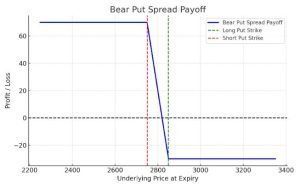
Bear Put Spread Strategy Payoff Graph
-
Flat loss if price doesn’t fall
-
Profit rises as price drops — max gain at or below lower strike
-
Range-bound, risk-defined strategy
Strategy Summary Table:
Component |
Action |
Strike |
Premium |
|---|---|---|---|
Long Put |
Buy |
₹2,850 |
₹60 |
Short Put |
Sell |
₹2,750 |
₹30 |
Net Premium |
– |
– |
₹30 |
Max Profit |
– |
– |
₹20,000 (spread – premium × lot) |
Max Loss |
– |
– |
₹7,500 (net premium × lot) |
Greek Impact on Bear Put Spread Strategy
Greek |
Effect |
|---|---|
Delta |
Negative (mild bearish bias) |
Theta |
Slightly Negative (loses value slowly over time) |
Vega |
Moderate – sensitive to volatility rise (helps Long Put more than hurts Short Put) |
Strike Price Selection Tips:
-
Choose Long Put slightly OTM or ATM
-
Choose Short Put lower OTM
-
Make sure the spread is not too wide (100–200 points works well)
-
Ideal for high IV (volatility) environments
Do’s and Don’ts
Do’s:
-
Use when expecting limited downside
-
Always calculate risk/reward upfront
-
Use monthly expiry for better time decay management
Don’ts:
-
Avoid very wide strike gaps unless you expect a big move
-
Don’t use this strategy in sideways or bullish markets
-
Don’t hold to expiry blindly — monitor your P&L
Pro Tips:
-
Combine with technical support zones or news triggers
-
A great strategy for budget traders — limited risk and smaller premium than buying a naked Put
-
Works well on stocks post weak results or negative sentiment
Bear Put Spread Cheat Sheet
| Feature | Value |
|---|
| Max Profit | Strike Difference – Net Premium |
| Max Loss | Net Premium Paid |
| Breakeven | Long Put Strike – Net Premium |
| Ideal View | Mild Bearish |
| Capital Used | Low to Medium |
Bear Put Spread Strategy Quick Summary:
| Factor | Bear Put Spread |
|---|
| Market View | Moderately Bearish |
| Risk | Limited to net premium paid |
| Reward | Limited (difference in strikes – net debit) |
| Greeks | Positive Vega, Negative Theta |
| Best Used When | Market is falling with medium volatility |
| Capital Required | Low (due to premium credit from short leg) |
Conclusion – Bear Put Spread Strategy
The Bear Put Spread is one of the safest and smartest ways for beginners to trade when they have a bearish outlook on a stock or index but want to limit their risk.
With this strategy, you’re essentially saying:
“I think the market will go down, but I don’t want to risk a lot of capital in case I’m wrong.”
By buying a Put and selling a lower strike Put, you:
-
Reduce your upfront cost (compared to buying just a Put)
-
Limit your maximum loss
-
Define your maximum profit
-
Get a balanced trade that benefits from both price drop and time decay
Final Tip:
Use Bear Put Spread when you’re moderately bearish, and always align your strikes with support/resistance zones on the chart. This adds a technical edge to your options strategy.
Please do not just speculate while trading in stock market in any segment, instead look for learning new strategies.
If, you have liked the content please do share it with your friends or on social media, as sharing do bring the good karma. If you have any questions or feedback you can leave them in comment box below.
🔗 Related Learning
- Technical Analysis Guide
- Fundamental Analysis Guide
- Financial Tools Hub
- Stock Broker Reviews Hub
- Ultimate Options Trading Guide
- Dhan DEXT Review
- How Option Trading Works
- Position Size Calculator
- Trading Expectancy Calculator
- Option Greeks Calculator
- Options Strategy Calculator
- Gift Nifty Opening Predictor
- F&O Breakeven Calculator
- Risk Reward Ratio Calculator
- Intraday Target Calculator
- Drawdown Recovery Calculator
Disclaimer:
This content is intended for educational purposes only and does not constitute financial or investment advice. Options trading involves substantial risk and may not be suitable for all investors. Past performance is not indicative of future results. Always do your own research or consult a SEBI-registered financial advisor before making any trading decisions. The examples provided are for illustration only and do not represent any recommendations.