Most retail traders enter the market thinking about one thing:
profits.
Professional traders think differently.
For institutions, hedge funds, proprietary trading desks, and large investors, survival matters more than prediction.
Because in real markets:
- volatility is constant,
- uncertainty never disappears,
- and even the best traders can be wrong.
That’s why institutional trading is built around one core principle:
Risk Management First.
And one of the most important tools used for risk management is:
Hedging.
In this guide, we’ll explain:
- what hedging actually means,
- how institutional traders use it,
- how options & futures help reduce risk,
- real examples with calculations,
- common hedging mistakes,
- and why hedging matters even for retail traders.
Most importantly:
we’ll explain it in simple language that beginners can easily understand.
What Is Hedging?
Hedging means:
reducing potential losses by taking another position that offsets your risk.
Think of it like insurance.
Example:
- You buy health insurance not because you want to get sick,
- but because you want protection if something goes wrong.
Hedging works similarly in financial markets.
Institutional traders hedge because:
- markets can crash unexpectedly,
- volatility can spike suddenly,
- global news can change sentiment instantly.
Instead of relying purely on prediction,
they use hedging to reduce damage.
Simple Hedging Example (Beginner-Friendly)
Suppose:
- You own ₹1,00,000 worth of banking stocks
- You believe markets may become volatile next month
Instead of selling everything,
you buy protection using:
Bank Nifty Put Options.
If markets fall:
- your stock portfolio loses value,
- but your put option gains value.
That gain helps reduce your overall loss.
That is hedging.
Why Institutional Traders Hedge?
Professional traders rarely keep large unprotected exposure.
Why?
Because protecting capital is more important than maximizing every possible profit.
Institutions hedge for several reasons:
1. Protect Against Market Crashes
Markets can move violently during:
- elections,
- wars,
- interest-rate decisions,
- global recessions,
- geopolitical tensions.
Hedging helps reduce downside impact.
2. Reduce Portfolio Volatility
Large investors prefer smoother returns over extreme swings.
Hedging helps stabilize portfolio performance.
3. Protect Leveraged Positions
Many institutions trade using leverage.
Without hedging:
small market moves can create massive losses.
4. Maintain Long-Term Investments
Sometimes investors still believe in long-term growth,
but expect short-term volatility.
Instead of selling holdings,
they hedge temporarily.
How Hedging Works in Real Markets?
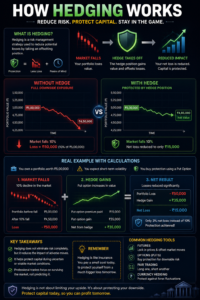
Visual explanation of how traders and institutions use hedging to reduce losses during market volatility.
There are multiple ways institutions hedge risk.
Let’s understand the most common ones.
1. Futures Hedging
This is one of the most widely used institutional hedging methods.
Real Example With Calculation
Suppose a fund owns:
- ₹50 lakh worth of banking stocks
But they expect:
- short-term weakness in markets.
Instead of selling stocks,
they short:
Bank Nifty Futures.
Scenario A — No Hedge
Portfolio Value:
₹50,00,000
Market Falls:
10%
Portfolio Loss:
₹5,00,000
Total Value Left:
₹45,00,000
Scenario B — With Futures Hedge
The fund shorts Bank Nifty Futures.
Market Falls 10%.
Now:
- stock portfolio loses ₹5,00,000
- but futures short position gains ₹4,20,000
Net Loss:
Only ₹80,000 (excluding costs/slippage)
Result
Instead of losing ₹5 lakh,
the hedge dramatically reduced portfolio damage.
That’s the power of hedging.
2. Options Hedging
Options are another major hedging tool.
Institutions often buy:
Put Options
for downside protection.
Simple Put Option Example
Suppose:
- You own shares worth ₹2,00,000
- Nifty is trading at 25,000
You buy:
- 1 protective put option costing ₹5,000
This acts like insurance.
Scenario A — Market Crashes
Portfolio Loss:
₹30,000
Put Option Gain:
₹22,000
Net Loss:
Only ₹8,000 + premium cost
Scenario B — Market Rises
Portfolio Gains:
₹20,000
Put Option Expires Worthless:
Loss = ₹5,000 premium
Net Gain:
₹15,000
Important Insight
Hedging is NOT free.
Like insurance:
- it protects downside,
- but also costs money.
This is why institutions carefully balance:
- protection,
- cost,
- and expected volatility.
3. Pair Trading Hedging
Institutions also hedge using:
pair trades.
Example:
- Buy strongest banking stock
- Short weaker banking stock
This reduces:
- overall sector risk,
- while focusing on relative performance.
Simple Example
Trader believes:
- HDFC Bank will outperform another banking stock.
So they:
- buy ₹10 lakh HDFC Bank
- short ₹10 lakh weaker bank
Now:
- overall market direction matters less,
- relative performance matters more.
This is called:
market-neutral positioning.
4. Currency Hedging
Large institutions with international exposure also hedge currency risk.
Example:
- Indian company imports crude oil in dollars
- Dollar strengthens sharply
- Import costs rise significantly
To reduce this risk,
companies hedge using:
- currency futures,
- forex derivatives,
- forward contracts.
Why Retail Traders Often Ignore Hedging?
Most retail traders focus only on:
- maximum profits,
- leverage,
- aggressive returns.
Very few think about:
downside protection.
Common reasons:
- lack of education,
- greed,
- overconfidence,
- misunderstanding derivatives,
- social media “YOLO” trading culture.
Professional traders operate very differently.
Institutions Focus More on Survival Than Prediction
This is one of the biggest differences between:
- amateurs,
- and professionals.
Retail traders often ask:
“How much can I make?”
Institutions ask:
“How much can I lose?”
That mindset shift is extremely important.
How Modern Trading Platforms Support Hedging
Modern platforms like Dhan now provide:
- advanced options chains,
- Greeks visualization,
- strategy builders,
- payoff graphs,
- multi-leg order execution,
- risk-analysis tools.
These tools make:
- hedging,
- options strategies,
- and risk management
far more accessible than before.
Especially for:
- options traders,
- active traders,
- professional market participants.
If you want:
✅ faster execution
✅ advanced options tools
✅ better workflow
✅ real-time analytics
✅ professional trading infrastructure
then it’s worth exploring Dhan and experiencing DEXT T3 yourself.
👉 Open your free Dhan account today and see why more serious traders are shifting toward modern trading ecosystems instead of outdated broker platforms.
Because in trading:
⚔️ Better tools don’t guarantee profits — but they absolutely improve decision-making, execution, and efficiency. And over time, that edge matters a lot.
Risks of Hedging
Hedging reduces risk,
but it does NOT eliminate risk completely.
Poor hedging can also create problems.
1. Hedging Costs Money
Options premiums,
slippage,
and transaction costs reduce returns.
2. Overhedging
Too much protection can:
- reduce profits heavily,
- and hurt long-term performance.
3. Wrong Correlations
Sometimes assets stop moving as expected.
A hedge may fail during extreme volatility.
4. Complexity
Advanced hedging strategies require:
- discipline,
- understanding,
- and constant monitoring.
Unhedged vs Hedged Portfolio Example
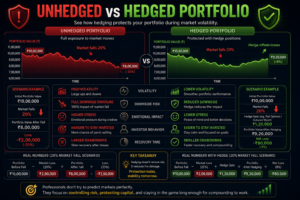
Scenario |
Unhedged Portfolio |
Hedged Portfolio |
|---|---|---|
Market Falls 10% |
-₹1,00,000 |
-₹25,000 |
Market Rises 10% |
+₹1,00,000 |
+₹80,000 |
Volatility |
Very High |
Lower |
Stress Level |
High |
More Controlled |
Important Beginner Lesson
Hedging is not designed to:
maximize profits.
It is designed to:
reduce catastrophic losses.
This is why institutions survive market crashes better than most retail traders.
Real-World Institutional Hedging Examples

Professional traders hedge constantly during:
- elections,
- RBI policy meetings,
- earnings season,
- geopolitical tensions,
- budget announcements,
- global market panic.
Even long-term investors hedge during uncertainty.
Because preserving capital matters.
Difference Between Speculation and Hedging
Speculation |
Hedging |
|---|---|
Goal = Profit |
Goal = Protection |
Higher directional exposure |
Reduced risk exposure |
Often aggressive |
Usually defensive |
Focus on returns |
Focus on survival |
This distinction is very important.
Conclusion
Institutional traders do not survive because they predict markets perfectly.
They survive because:
- they manage risk professionally,
- control downside exposure,
- protect capital during volatility,
- and avoid catastrophic losses.
That is why hedging plays such an important role in modern financial markets.
Whether through:
- futures,
- options,
- pair trading,
- or currency protection,
hedging helps institutions stay stable during uncertain conditions.
For retail traders and investors, understanding hedging is equally valuable.
Because long-term success in markets is not just about making money during bull runs —
it’s about protecting yourself during difficult periods too.
And in real markets:
risk management is often more important than prediction.
The Indian trading ecosystem is evolving rapidly.
Traders today no longer want just:
- a basic broker app
- simple charts
- standard order placement
They want:
✅ speed
✅ precision
✅ advanced analytics
✅ better workflow
✅ real-time execution
✅ professional-grade tools
And this is exactly where modern platforms like Dhan are changing the game.
DEXT T3 is not just another trading interface.
It is designed more like a complete trading workstation built for:
- intraday traders
- options traders
- scalpers
- serious active market participants
From:
- multi-screen workflow
- real-time Greeks
- advanced options ecosystem
- native TradingView integration
- fast execution
- SLBM passive income
- Gold Vault ownership
Dhan is clearly building something much bigger than a traditional discount broker.
If you are a casual investor who only occasionally buys stocks or SIPs, then almost any platform may work for you.
But if you are serious about:
- active trading
- options strategies
- execution quality
- workflow efficiency
- market analysis
then DEXT T3 is easily one of the most powerful trading terminals currently available in India.
Most brokers still feel like:
👉 “basic trading apps”
DEXT T3 feels like:
👉 a modern professional trading ecosystem.
And honestly, once traders experience:
- cleaner workflow
- better visibility
- faster execution
- deeper analytics
it becomes difficult to go back to limited platforms.
So, if you trade intraday, options, or scalping, the difference in execution speed and advanced tools alone make switching worth it. I personally did.
If you’re looking for a modern, feature-rich, and trader-friendly platform, Dhan is easily one of the best choices available today. From zero account opening charges to advanced tools like native TradingView, options strategy builder, and free API access, Dhan is clearly built with the modern Indian trader in mind.
With Dhan you can also invest and trade in IPO’s, NFO’s, SIP, Bonds, ETF, SGB, and many other financial products with so much ease.
Whether you’re an intraday trader, an options strategist, or a long-term investor, Dhan offers the perfect blend of speed, simplicity, and smart technology — without burning a hole in your pocket.
Why wait? Open your Dhan account now and take control of your trading journey with confidence.
👉 Click here to get started with Dhan
Frequently Asked Questions (FAQs)
1. What is hedging in the stock market?
Hedging is a strategy used to reduce potential losses by taking another position that offsets existing market risk.
2. Why do institutional traders hedge?
Institutions hedge to:
- reduce volatility,
- protect capital,
- manage leverage,
- and survive uncertain market conditions.
3. Is hedging only for professionals?
No. Retail investors can also use simple hedging strategies using:
- options,
- futures,
- or asset diversification.
However, proper understanding is important before using derivatives.
4. Does hedging eliminate losses completely?
No. Hedging reduces risk but does not guarantee complete protection.
5. Why do options help in hedging?
Put options can increase in value when markets fall, helping offset losses in stock portfolios.
6. What is the biggest benefit of hedging?
The biggest benefit is:
downside protection during extreme market volatility.
7. What is the downside of hedging?
Hedging costs money and may reduce overall profits during strong bull markets.
Disclaimer
This article is intended solely for educational and informational purposes and should not be considered financial, investment, trading, or legal advice. Derivatives, options, futures, and hedging strategies involve substantial market risk and may not be suitable for all investors. Please conduct your own research and consult a SEBI-registered financial advisor before making financial decisions.
Authorized Partner of Raise Securities Pvt. Ltd. SEBI Registration Number: INZ000006031 Stock Broking Agent Name: Amit Giri AP Registration Numbers: NSE: AP3008001601 BSE: AP01659301165098 MCX: AP168015 Investments in securities market are subject to market risks. Read all related documents carefully before investing.