Most retail investors think the stock market works only one way:
Buy low → Sell high → Make profit.
But modern financial markets are far more complex than that.
Around the world, traders also make money when prices fall. Institutions hedge billion-dollar portfolios by selling borrowed shares. Arbitrage desks exploit pricing inefficiencies. Derivatives traders manage exposure through sophisticated short-selling strategies.
And behind all of this exists a lesser-known market infrastructure most retail investors rarely see:
What Is Stock Borrowing?
In India, this process operates through a regulated framework known as the Stock Lending and Borrowing Mechanism (SLBM).
Understanding how short selling works is important not just for traders — but for long-term investors as well. Because even if you never short a stock yourself, your shares may still participate indirectly in this hidden ecosystem.
In this guide, we’ll break down:
- What short selling actually is
- Why traders borrow shares
- How SLBM works in India
- What causes short squeezes
- Risks involved
- Why stock borrowing matters in modern markets
What Is Short Selling?
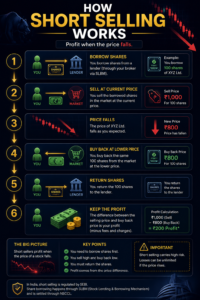
Short selling is a strategy where a trader attempts to profit from a decline in a stock’s price.
Unlike traditional investing:
- investors buy first and sell later,
- short sellers sell first and buy later.
That sounds strange initially, because:
How can someone sell shares they don’t own?
The answer:
They borrow them temporarily.
Simple Example of Short Selling
Let’s assume:
- A stock is trading at ₹1,000
- A trader believes the price may fall
The trader:
- Borrows 10 shares
- Sells them immediately at ₹1,000
- Receives ₹10,000
A few days later:
- Stock falls to ₹850
The trader now:
- Buys back 10 shares at ₹850
- Pays ₹8,500
- Returns shares to lender
Profit:
₹10,000 – ₹8,500 = ₹1,500 (excluding charges)
That difference becomes the trader’s gain.
Traditional Investing vs Short Selling
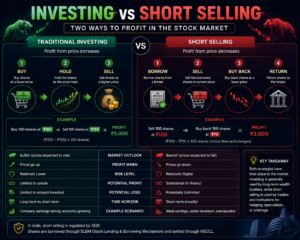
Traditional Investing |
Short Selling |
|---|---|
Buy first |
Sell first |
Profit when prices rise |
Profit when prices fall |
Risk limited to invested capital |
Risk can theoretically be unlimited |
Long-term investing common |
Mostly short-term trading/hedging |
Why Do Traders Short Stocks?
Many people assume short selling is purely speculative.
In reality, short selling is an important part of global market structure.
Professional traders use it for several legitimate purposes.
1. Hedging Risk
Institutions often short stocks or indices to reduce downside exposure.
Example:
- A fund owns banking stocks worth ₹50 crore
- They expect short-term volatility
- They may short Bank Nifty futures or banking shares as protection
This helps stabilize portfolio risk.
2. Arbitrage Strategies
Professional traders exploit temporary pricing differences between:
- cash market
- futures market
- ETFs
- options
Many arbitrage strategies require borrowed shares.
3. Bearish Trading View
Sometimes traders simply believe a stock is overvalued.
Instead of waiting for a crash while doing nothing, they may take a short position.
4. Market Efficiency
Short selling also contributes to:
- liquidity
- price discovery
- market efficiency
Without short sellers, overvalued stocks could remain irrationally priced for longer periods.
Why Borrowing Shares Is Necessary
This is where many beginners get confused.
In regulated markets:
You cannot permanently sell shares you don’t own.
So before a trader can short sell:
- shares must first be borrowed legally,
- through a regulated framework.
That framework in India is called:
SLBM — Stock Lending and Borrowing Mechanism
What Is SLBM?
SLBM is a SEBI-regulated mechanism that allows:
- investors to lend shares temporarily,
- and traders/institutions to borrow them.
The entire process happens through exchange-backed infrastructure.
In India, this ecosystem operates via:
- NSE
- clearing corporations like NSCCL
- brokers offering SLBM access
This ensures:
- collateral management
- settlement guarantees
- regulated execution
How SLBM Works in India
Here’s the simplified flow:
Step 1 — Investor Lends Shares
A long-term investor agrees to lend shares temporarily.
Step 2 — Borrower Takes Shares
A trader or institution borrows them for:
- short selling
- hedging
- arbitrage
Step 3 — Borrower Pays Lending Fee
The lender earns:
- rental income
- lending yield
This is the “stock rent.”
Step 4 — Shares Returned After Expiry
At contract completion:
- shares are returned,
- settlement happens automatically.
Why Would Investors Lend Their Shares?
This is where SLBM becomes interesting for long-term investors.
Normally, many portfolios remain idle for months.
With stock lending:
- the investor still retains long-term ownership exposure,
- while potentially generating additional income.
That creates:
a secondary income layer on existing holdings.
This is one reason why institutional investors globally participate heavily in securities lending markets.
Who Usually Borrows Shares?
Borrowers are typically:
- institutional traders
- arbitrage desks
- hedge funds
- derivatives traders
- proprietary trading firms
Retail participation exists too, but institutional demand dominates the ecosystem.
Why Some Stocks Become “Hard to Borrow”
Not every stock has the same borrowing demand.
Certain stocks attract higher short-selling activity because of:
- high volatility
- heavy derivatives activity
- speculative momentum
- lower floating supply
- event-driven trading
This creates situations where:
- borrowing demand rises sharply,
- and lending fees increase.
Globally, these are sometimes referred to as:
“hard-to-borrow” stocks.
What Is a Short Squeeze?
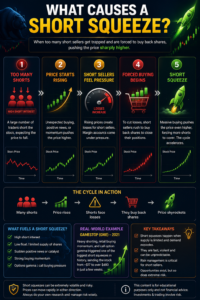
A short squeeze happens when:
- too many traders are short,
- but the stock suddenly rises aggressively.
As prices rise:
- short sellers start facing losses,
- margin pressure increases,
- forced buying begins.
This buying pressure pushes prices even higher.
The result can become explosive.
Some of the biggest market rallies globally were driven by short squeezes.
Why Short Selling Is Risky
Short selling is significantly riskier than traditional investing.
Why?
Because when you buy a stock:
- maximum loss = invested amount
But in short selling:
- losses can theoretically become unlimited.
Example:
- You short at ₹500
- Stock rises to ₹900
Losses continue increasing as price rises.
That’s why professional traders rely heavily on:
- risk management
- stop losses
- margin monitoring
- position sizing
Risks Associated With Short Selling
1. Unlimited Loss Potential
Unlike investing, losses theoretically have no upper limit.
2. Margin Calls
If losses rise sharply, brokers may require additional capital.
3. High Volatility
Short squeezes can create violent price spikes.
4. Borrowing Costs
Some shares become expensive to borrow during high demand periods.
5. Regulatory Restrictions
Short-selling rules can change during extreme market conditions.
How Retail Investors Indirectly Participate
Modern broker platforms have made SLBM more accessible than before.
Platforms like Dhan now provide:
- retail SLBM access,
- stock lending visibility,
- integrated workflows for active market participants.
This has gradually increased awareness around:
- stock lending,
- borrowing demand,
- passive portfolio monetization.
Still, SLBM remains relatively underexplored among Indian retail investors compared to developed markets.
💰 Why Rent Stocks on Dhan?
Renting your stocks through Dhan isn’t just easy — it’s smarter, faster, and fully online.
Here’s what makes Dhan’s SLBM feature a game-changer:
Benefit |
What It Means for You |
|---|---|
Dual Income Strategy |
Earn both from stock appreciation and rental income. |
Passive Income |
Rental income is credited instantly — no waiting period. |
Zero Additional Risk |
Transactions are fully exchange-settled via NSCCL, ensuring 100% safety. |
Complete Flexibility |
Choose which stocks to rent, and recall anytime before expiry. |
Market-Leading Returns |
Earn yields ranging from 6% to 24% p.a. depending on demand. |
💡 Pro Tip: The demand for certain blue-chip and high-volume stocks can fetch higher rental rates.
Getting started is quick and simple — takes less than a minute!
-
Activate SLBM on your Dhan account
-
One-time activation fee: ₹199 for SLBM and ₹100 for DDPI (to cover processing costs).
-
-
Visit “Rent Stocks” section on Dhan App or Web.
-
Check Live Market Demand for eligible stocks in your portfolio.
-
Rent at Market Demand or Make an Offer manually.
-
Track all rentals from your Rental Portfolio dashboard on Dhan.
Once rented, the stocks move temporarily from your demat to the borrower’s account via the exchange. After expiry, they automatically return within 24–48 hours.
You can activate SLBM in less than 5 minutes. Here’s how:
- Open Dhan A/c and head to Rent Stocks on the home screen
- Click Activate, provide your consent, and proceed
- Pay the one-time fee of ₹199 (₹298 if DDPI is not activated)
- Provide your e-Sign
- SLBM will activate in 5 minutes
🔒 Is It Safe?
Absolutely.
Renting stocks via SLBM is fully regulated by SEBI and settled through NSCCL, which guarantees every transaction.
Your holdings remain safe, and you can recall your stocks anytime before the contract expiry.
🌟 Why Dhan Leads the Way
Dhan’s focus has always been innovation with transparency.
They’ve built powerful features that make trading and investing seamless:
-
DEXT – Their proprietary trading platform (recognized by Amazon AWS)
-
Instant Pledge & Unpledge
-
Super Orders
-
Instant Withdrawals
-
Mutual Funds in Demat Format
-
Portfolio Tracking (across banks, stocks & mutual funds)
- Gold vault
Now, with Rent Stocks via SLBM, they’re helping you unlock a whole new way to earn from the markets — safely and smartly.
🪙 Start Earning Extra Income — Today
Your stocks are valuable assets — don’t let them sit idle.
Rent them through Dhan’s SLBM and start earning passive income today.
👉 Open Your Free Dhan Account
and experience the future of investing and trading — built for India’s Super Investors & Traders.
Why Understanding Short Selling Matters
Even if you never short a stock yourself, understanding short selling helps you:
- interpret market behavior better,
- understand volatility,
- identify short squeeze conditions,
- understand institutional positioning,
- learn how modern markets actually function.
Markets are not driven only by:
- long-term investors,
- SIP flows,
- bullish traders.
They are also influenced by:
- hedging activity,
- derivatives positioning,
- leverage,
- securities lending,
- institutional risk management.
And short selling sits at the center of that ecosystem.
Conclusion
Short selling is often misunderstood as reckless speculation.
In reality, it is a core component of modern financial markets.
It enables:
- hedging,
- liquidity,
- arbitrage,
- price discovery,
- institutional risk management.
And behind every short sale exists an entire ecosystem of stock borrowing operating quietly in the background.
For long-term investors, understanding SLBM and securities lending also opens a different perspective:
portfolios are not just assets that appreciate over time — they can also become productive financial instruments within broader market infrastructure.
Whether you are:
- an investor,
- active trader,
- options participant,
- or simply trying to understand how markets really work,
learning about short selling provides a much deeper understanding of modern market mechanics.
Frequently Asked Questions (FAQs)
1. Is short selling legal in India?
Yes. Short selling is legal in India under SEBI-regulated frameworks. Institutional and retail participants can short sell using approved exchange mechanisms and derivatives products.
2. What is SLBM in the stock market?
SLBM stands for Stock Lending and Borrowing Mechanism. It allows investors to lend shares temporarily while borrowers use them for trading or hedging purposes.
3. Why do traders borrow stocks?
Traders borrow stocks mainly for:
- short selling,
- arbitrage,
- derivatives hedging,
- and institutional trading strategies.
4. Can retail investors participate in SLBM?
Yes. Some brokers now offer retail access to SLBM infrastructure, allowing investors to lend eligible shares through exchange-regulated systems.
5. Is short selling risky?
Yes. Short selling carries substantial risk because losses can theoretically become unlimited if stock prices rise sharply.
6. What is a short squeeze?
A short squeeze occurs when rising stock prices force short sellers to buy shares back quickly, causing even more upward price movement.
7. Do investors lose ownership while lending shares?
Shares are temporarily transferred during the lending contract, but the lending process remains regulated and settlement-backed through exchange infrastructure.
Disclaimer
This article is intended purely for educational and informational purposes and should not be considered investment, trading, legal, or financial advice. Securities markets involve risk, including the possibility of capital loss. Short selling and stock lending involve additional complexities and may not be suitable for all investors. Please conduct your own research and consult a SEBI-registered financial advisor before making any investment or trading decisions.
Authorized Partner of Raise Securities Pvt. Ltd. SEBI Registration Number: INZ000006031 Stock Broking Agent Name: Amit Giri AP Registration Numbers: NSE: AP3008001601 BSE: AP01659301165098 MCX: AP168015 Investments in securities market are subject to market risks. Read all related documents carefully before investing.