HUF Explained: Tax Benefits, Rules, Calculations, Examples & Wealth Building Through a Hindu Undivided Family
For most Indian families, taxes are paid individually.
Your salary is taxed in your name.
Your investments are taxed in your name.
Your rental income is taxed in your name.
But Indian tax laws recognize another legal and tax entity that many families either ignore or don’t fully understand — the Hindu Undivided Family (HUF).
A HUF can have its own PAN, bank account, investments, tax return, and even stock market portfolio.
For families with investments, rental income, businesses, or long-term wealth-building goals, understanding how a HUF works can unlock significant tax planning and asset management opportunities.
This guide explains HUFs in simple language with practical examples, tax calculations, and investing scenarios.
What Is a Hindu Undivided Family (HUF)?
A Hindu Undivided Family (HUF) is a separate legal and tax entity recognized under Indian law.
It consists of:
- A common ancestor
- His descendants
- Their spouses
The family collectively forms a HUF.
Unlike an individual taxpayer, a HUF can:
- Obtain its own PAN card
- Open a bank account
- Own assets
- Invest in stocks and mutual funds
- Earn rental income
- File a separate income tax return
Think of a HUF as a family-owned financial entity.
Simple Example
Suppose Raj lives with:
- His wife
- Son
- Daughter
Together they can constitute a HUF.
The HUF can:
- Open a bank account
- Buy property
- Invest in stocks
- Earn income
- Pay taxes separately from Raj’s personal income
This separate tax identity is what makes HUFs valuable for wealth planning.
Who Manages a HUF?
Every HUF is managed by a person known as the Karta.
The Karta:
- Represents the HUF
- Signs legal documents
- Operates bank accounts
- Makes investment decisions
- Files tax returns
Traditionally, the senior-most member acts as Karta.
However, legal developments have expanded eligibility in many situations.
How Is a HUF Created?
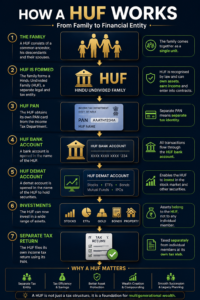
One of the biggest misconceptions is that a HUF needs to be “registered.”
In reality, a HUF comes into existence automatically in a Hindu family.
To start operating financially, families usually:
Step 1: Create a HUF Deed
The deed identifies:
- Name of HUF
- Karta
- Coparceners
- Initial corpus
Step 2: Apply for HUF PAN
The HUF receives a separate PAN number.
Step 3: Open a HUF Bank Account
All HUF transactions should flow through this account.
Step 4: Start Investing or Holding Assets
The HUF can now:
- Buy stocks
- Hold ETFs
- Purchase property
- Earn rental income
- Operate businesses
Dhan has specifically built a modern onboarding flow for HUF investors. Some key advantages:
1. 100% Digital Onboarding (No Branch Visits)
Earlier, HUF accounts meant physical forms, long TATs, and courier hassles. Dhan has turned this into a fully digital, ~10-minute process, from KYC to e-sign.
No paperwork, no scanning huge forms, no back-and-forth with support.
2. ₹0 AMC, Free HUF Demat
You can open a HUF demat account on Dhan for free with ₹0 AMC (Annual Maintenance Charges) for life, which keeps long-term family investing very cost-efficient.
3. Tax Savings at Family Level
Because the HUF is a separate tax entity, profits from trading and investing in the HUF demat account are taxed separately from individual members. This helps in:
-
Better use of tax slabs
-
Splitting income between individual and HUF
-
More efficient overall family taxation year on year
4. Unified, Legacy-Friendly Portfolio
All family investments held in one place:
-
Single dashboard for equities, ETFs, bonds, etc.
-
Easier succession & inheritance – assets stay in the HUF; only Karta changes when needed
5. Dhan Platform Features for HUF
With a HUF demat on Dhan, you also get:
-
Fast execution trading platforms (web, app, TradingView integration)
-
Tools for F&O, options trading, scanners, screeners, etc.
Why Do People Create a HUF?
The primary reason is that a HUF is treated as a separate taxpayer.
This means:
- Separate PAN
- Separate tax return
- Separate deductions
- Separate tax liability
This can help families manage income and assets more efficiently.
HUF Tax Benefits Explained

The biggest advantage of a HUF is that it enjoys the same basic tax treatment available to an individual taxpayer.
The HUF gets:
- Separate tax slab
- Separate deductions (where applicable)
- Separate return filing
This creates opportunities for legitimate tax planning.
Example: Individual vs HUF Taxation
Suppose Raj earns:
Personal Income
Salary: ₹18,00,000
Family Rental Property
Annual Rent: ₹5,00,000
Scenario 1: No HUF
Total Income:
₹18,00,000 + ₹5,00,000
= ₹23,00,000
Entire income taxed under Raj.
Scenario 2: Rental Income Belongs to HUF
Raj’s Income:
₹18,00,000
HUF Income:
₹5,00,000
Now:
- Raj files his return
- HUF files a separate return
Income is taxed separately.
The exact tax outcome depends on the tax regime and deductions applicable, but the key benefit is that income is no longer concentrated under one taxpayer.
HUF and Wealth Building

Most people think HUFs are only about taxes.
In reality, they are often more useful for long-term asset management.
A HUF can own:
- Equity shares
- ETFs
- Gold ETFs
- Bonds
- Mutual funds
- Real estate
- Business interests
Over time, this creates a dedicated family investment pool.
Example: Building Wealth Through a HUF
Suppose a family contributes ₹5 lakh to a HUF.
The HUF invests in:
- Nifty ETF
- Gold ETF
- Government Bonds
Assume a 12% annual return.
After 10 Years
Initial Investment: ₹5,00,000
Future Value:
≈ ₹15,53,000
After 20 Years
≈ ₹48,23,000
After 30 Years
≈ ₹1.49 Crore
The HUF becomes a vehicle for multigenerational compounding.
Can a HUF Invest in the Stock Market?
Yes.
A HUF can invest in:
- Stocks
- ETFs
- Sovereign Gold Bonds
- Bonds
- IPOs
- Derivatives (subject to broker requirements)
To do so, the HUF typically requires:
- HUF PAN
- HUF Bank Account
- HUF Demat Account
- KYC Compliance
Many investors use HUF accounts to separate family investments from personal portfolios.
Step-by-Step: How to Open a HUF Demat Account with Dhan (Online Process)
Below is a generic step-by-step flow based on Dhan’s current HUF onboarding experience. The actual screens may change slightly over time, but the logic remains similar.
Step 1: Go to Dhan’s HUF Account Opening Page
-
Visit Dhan’s dedicated HUF demat account page or HUF onboarding link.
Step 2: Verify Mobile Number & Email of the Karta
-
Enter the mobile number of the Karta.
-
Enter email ID of the Karta.
-
Verify both via OTP.
This becomes the primary contact for all HUF account communications (alerts, statements, OTPs, etc.).
Step 3: Enter HUF & Karta Details
On the next screen, you’ll typically fill:
-
HUF Details
-
HUF Name (exactly as per PAN)
-
HUF PAN
-
HUF Date of Formation
-
-
Karta Details
-
Name as per PAN
-
Date of birth
-
PAN & Aadhaar number
-
Address (auto-fetched via Aadhaar in many cases)
-
Dhan uses this to map KYC with both the HUF entity and the Karta.
Step 4: Add Bank Details of the HUF
-
Enter the HUF bank account number and IFSC code.
-
Upload one of:
-
Cancelled cheque with HUF name, or
-
Recent bank statement / passbook (as per instructions on page).
-
This is the account where payouts, dividends and IPO refunds will be credited.
Step 5: Upload Required Documents
Upload clear, readable copies of:
-
HUF PAN card
-
HUF address proof (bank statement/passbook)
-
HUF declaration / deed
-
Karta PAN
-
Karta Aadhaar
-
Income proof (if activating F&O or high-risk segments)
Make sure all edges are visible, details readable, and file size is within the specified limit.
Step 6: Segment Selection (Equity, F&O, Commodities, etc.)
Choose which segments you want to enable for the HUF:
-
Equity Delivery & Intraday
-
Equity F&O
-
Currency
-
Commodities
If you select F&O, income proof is mandatory; ensure you’ve uploaded it in the previous step.
Step 7: IPV / In-Person Verification (If Prompted)
Many digital brokers complete IPV through:
-
Short video recording or
-
Live webcam capture
Follow on-screen prompts (show PAN/Aadhaar to camera if asked). This is a regulatory requirement to confirm identity.
Step 8: e-Sign the HUF Demat Account Form
-
Review the filled form details for HUF and Karta.
-
Proceed to e-Sign using Aadhaar-based OTP (Karta’s Aadhaar).
-
Once successfully e-signed, your form is submitted for processing.
Step 9: Account Approval & CDSL Beneficiary ID
After verification by Dhan:
-
You’ll receive your client ID / login details, and
-
CDSL beneficiary ID for the HUF demat account
From here, you can log into Dhan Web/App and start investing/trading on behalf of your HUF.
Charges for HUF Demat Account on Dhan
From Dhan’s HUF page and support documentation:
-
Account Opening: Free
-
AMC (Annual Maintenance Charge): ₹0 (lifetime, as per current offer)
-
Brokerage & other charges: As per standard Dhan pricing plan for segments
-
DDPI (for non-individuals): There may be an offline DDPI process with a specific charge (e.g. ₹500 + GST) – always cross-check latest charges on Dhan’s pricing/FAQ page.
Important: Pricing and charges can change. Always verify the latest structure on Dhan’s official website before finalizing your content.
Open HUF Demat Account on Dhan
Tax-efficient investing for family wealth
- ⚡ 100% digital HUF onboarding (~10 mins)
- 💸 ₹0 AMC • Free HUF Demat for life
- 📊 Separate taxation at HUF level
- 🧾 Better use of tax slabs & income split
- 🏦 Unified family portfolio & easy succession
📱 Scan or tap — start HUF account in 10 minutes

No branch visits • No paperwork • CA-friendly
Example: HUF Stock Portfolio
Suppose a HUF invests:
Asset |
Amount |
|---|---|
Nifty ETF |
₹4,00,000 |
Gold ETF |
₹2,00,000 |
Blue-Chip Stocks |
₹4,00,000 |
Total Portfolio:
₹10,00,000
If the portfolio grows to ₹14,00,000:
Capital Gain:
₹4,00,000
The gain belongs to the HUF and is taxed accordingly under the HUF’s return.
HUF for Active Traders
A lesser-known use case is trading activity.
Some families use HUFs for:
- Equity trading
- Futures & Options
- Commodity trading
Benefits include:
- Separation of personal and family trading capital
- Separate accounting
- Separate tax records
However, trading income introduces additional compliance requirements.
Professional tax advice is recommended before operating an active trading business through a HUF.
[Open Your Free HUF Demat Account on Dhan →]
HUF vs Individual Investing
Feature |
Individual |
HUF |
PAN |
Personal |
Separate |
Tax Return |
Individual |
Separate |
Bank Account |
Personal |
Separate |
Investments |
Personal |
Family-owned |
Succession Planning |
Limited |
Better Structured |
Asset Pooling |
No |
Yes |
HUF vs Family Trust
Many wealthy families eventually compare HUFs with trusts.
Factor |
HUF |
Family Trust |
Setup Cost |
Low |
Higher |
Compliance |
Simple |
More Complex |
Tax Structure |
Defined |
Flexible |
Wealth Transfer |
Moderate |
Strong |
Control Mechanism |
Karta |
Trustees |
For most middle-class and upper-middle-class families, a HUF is usually the simpler starting point.
Common HUF Mistakes
Mixing Personal and HUF Funds
Always maintain separate accounts.
Using Personal Assets as HUF Assets
Documentation must clearly establish ownership.
Improper Record Keeping
Maintain:
- Bank statements
- Investment records
- Tax returns
Ignoring Clubbing Provisions
Certain transfers to HUF may attract clubbing provisions under tax laws.
Professional advice is recommended before transferring assets.
Who Should Consider a HUF?
A HUF may be useful if:
✓ Your family owns property
✓ You actively invest in markets
✓ You want separate family investments
✓ You are planning long-term wealth transfer
✓ Multiple family members contribute to family wealth
A HUF may be less useful if:
✗ You have no family assets
✗ You only earn salary income
✗ You have minimal investments
Final Thoughts
A Hindu Undivided Family is far more than a tax-saving structure.
It is a legally recognized family entity that can own assets, invest in markets, manage wealth, and create a framework for multigenerational financial planning.
While tax efficiency is often the primary attraction, the real advantage lies in creating a separate pool of family capital that can compound over decades.
For families with investments, rental income, businesses, or long-term wealth-building goals, understanding and properly utilizing a HUF can be a valuable part of an overall financial strategy.
🚀 Ready to Elevate Your Trading Game?
Start your journey with Dhan — India’s fastest, most reliable, and user-friendly stock broker app trusted by over 1 million users.
No hidden fees. No complicated processes. Just smart, seamless trading.
It takes less than 5 minutes to sign up and start trading.
Open HUF Demat Account on Dhan
Tax-efficient investing for family wealth
- ⚡ 100% digital HUF onboarding (~10 mins)
- 💸 ₹0 AMC • Free HUF Demat for life
- 📊 Separate taxation at HUF level
- 🧾 Better use of tax slabs & income split
- 🏦 Unified family portfolio & easy succession
📱 Scan or tap — start HUF account in 10 minutes
No branch visits • No paperwork • CA-friendly
If, you have liked the content please do share it with your friends or on social media, as sharing do bring the good karma. If you have any questions or feedback you can leave them in comment box below.
Frequently Asked Questions (FAQs)
1. What is a Hindu Undivided Family (HUF)?
A Hindu Undivided Family (HUF) is a separate legal and tax entity recognized under Indian law. It consists of lineal descendants of a common ancestor and their spouses. A HUF can have its own PAN card, bank account, investments, and income tax return.
2. Does a HUF Have a Separate PAN Card?
Yes. A HUF must obtain its own PAN card from the Income Tax Department. This PAN is separate from the PANs of individual family members and is used for taxation, banking, and investments.
3. Can a HUF Save Tax Legally?
A HUF is treated as a separate taxpayer under Indian tax laws. This means it can earn income, file a separate tax return, and be taxed independently. The actual tax benefit depends on the source of income, applicable tax regime, and individual circumstances.
4. Can a HUF Invest in Stocks and ETFs?
Yes. A HUF can invest in:
- Equity shares
- ETFs
- Bonds
- Sovereign Gold Bonds (SGBs)
- Mutual funds
- IPOs
To invest in securities, the HUF generally requires a PAN card, bank account, and demat account in the name of the HUF.
5. Can a HUF Open a Demat Account?
Yes. A HUF can open a demat and trading account with brokers that support non-individual accounts. The account is operated by the Karta on behalf of the HUF and all investments belong to the HUF entity.
6. Who Pays Tax on Income Earned by a HUF?
Income earned by the HUF is taxed in the hands of the HUF, not individual family members, subject to applicable tax rules. The HUF files its own income tax return using its PAN.
7. Can a Salaried Person Create a HUF?
Yes. A salaried individual who is part of a Hindu family can form and operate a HUF. However, the usefulness of a HUF generally increases when there are family assets, investments, rental income, gifts received by the HUF, or business income.
8. Can a HUF Do Intraday Trading and F&O Trading?
Yes. A HUF can participate in equity trading, intraday trading, futures, options, and commodity trading, subject to broker eligibility and regulatory requirements. Income from such activities may be treated differently for tax purposes, so professional tax advice is recommended.
9. What Happens If the Karta of a HUF Dies?
The HUF itself does not cease to exist. A new Karta is appointed according to applicable legal provisions and family structure. The assets, investments, and bank accounts of the HUF continue to remain with the HUF entity.
10. Can a HUF Own Property?
Yes. A HUF can own residential, commercial, or agricultural property in its own name. Rental income earned from such property is generally taxed in the hands of the HUF.
11. What Is the Difference Between a HUF and an Individual Taxpayer?
An individual taxpayer and a HUF are treated as separate tax entities.
A HUF can have:
- Separate PAN
- Separate bank account
- Separate investments
- Separate tax return
An individual taxpayer owns assets and earns income in a personal capacity.
12. Is a HUF Useful for Long-Term Wealth Building?
For families with investments, property, or business assets, a HUF can serve as a centralized structure for managing family wealth. It can simplify asset ownership, succession planning, and long-term investment management across generations.
13. HUF vs Family Trust: Which Is Better?
A HUF is generally simpler and less expensive to operate than a family trust. However, trusts may offer greater flexibility for complex succession and estate planning. The right choice depends on the family’s objectives, assets, and long-term wealth transfer requirements.
14. Can NRIs Be Members of a HUF?
Yes. An NRI can be a member (coparcener) of a HUF. However, taxation, investment eligibility, and banking rules can become more complex when non-resident members are involved. Professional advice is recommended in such situations.
15. What Is the Biggest Benefit of a HUF?
The biggest advantage of a HUF is that it creates a separate legal and tax identity for family assets and investments. Beyond potential tax planning benefits, it provides a structured framework for family wealth creation, asset management, and intergenerational wealth transfer.
Disclaimer
This article is for educational purposes only and should not be considered tax, legal, or financial advice. Tax laws change over time and individual circumstances differ. Consult a qualified Chartered Accountant or tax professional before creating a HUF or implementing any tax-planning strategy.
Authorized Partner of Raise Securities Pvt. Ltd. SEBI Registration Number: INZ000006031 Stock Broking Agent Name: Amit Giri AP Registration Numbers: NSE: AP3008001601 BSE: AP01659301165098 MCX: AP168015 Investments in securities market are subject to market risks. Read all related documents carefully before investing.